Mayan farmers grew maize, beans, and squash using a surprisingly lean toolkit: sharpened digging sticks for planting, stone axes for land clearing, hand-held scrapers and knives for harvesting, manos and metates for grinding grain, and baskets for hauling and storing everything. They paired those hand tools with serious landscape engineering, including raised fields, irrigation canals, and terraced hillsides, to manage water and soil across seasons. If you want to recreate that system in a modern home garden or homestead, most of what they did maps almost perfectly onto tools you can buy or build today.
What Tools Did Mayan Farmers Use to Grow Crops
Marcus Hendrick
1 Jun 2026
The big picture: how Mayan farmers thought about their toolkit
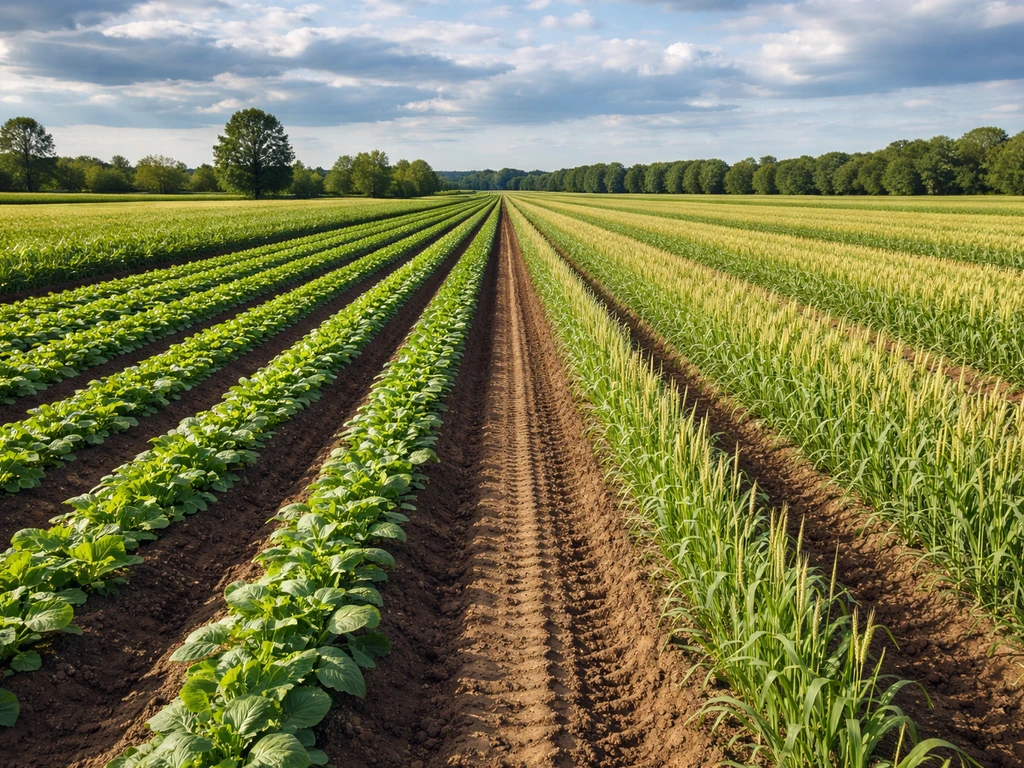
It is tempting to assume ancient farming meant primitive farming. That is not quite right with the Maya. Archaeologists describe Maya lowland agriculture as a sophisticated, multi-layered system that went well beyond simple slash-and-burn. Yes, milpa-style clearing and burning was common and persisted for centuries, but in wetland zones the Maya were also engineering raised field systems and canal networks that rival anything in the ancient world. The Pulltrouser Swamp site in Belize, for example, shows evidence of hydraulic raised-field agriculture stretching back to around 150 B.C. LiDAR surveys along the Rio Bravo River in northwest Belize have revealed whole canal and raised-field complexes hiding under the jungle canopy.
What makes this relevant to a home gardener is the underlying logic: the Maya matched their tools to their landscape. In uplands they terraced slopes and oriented furrows parallel to the hillside to control runoff. In wetlands they built raised beds above the waterline and dug drainage canals between them. Their hand tools handled the planting and harvesting. Their earthworks handled the water. That two-part system, portable hand tools plus permanent landscape modifications, is exactly how a well-run homestead works today.
Hand tools for land prep and planting
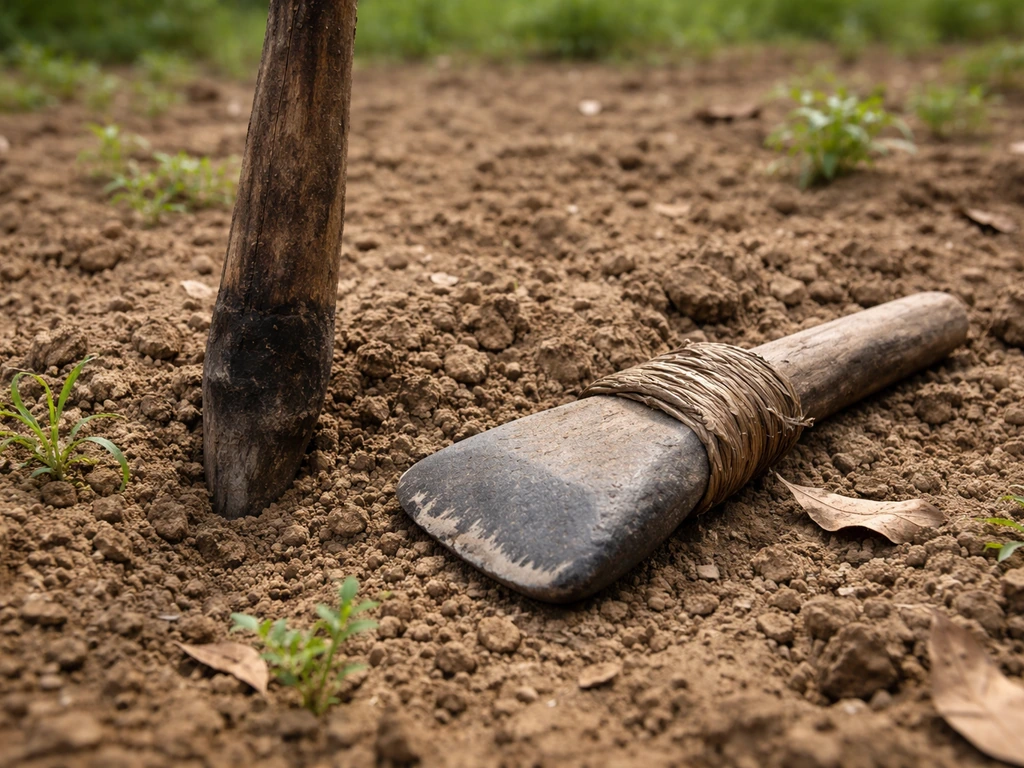
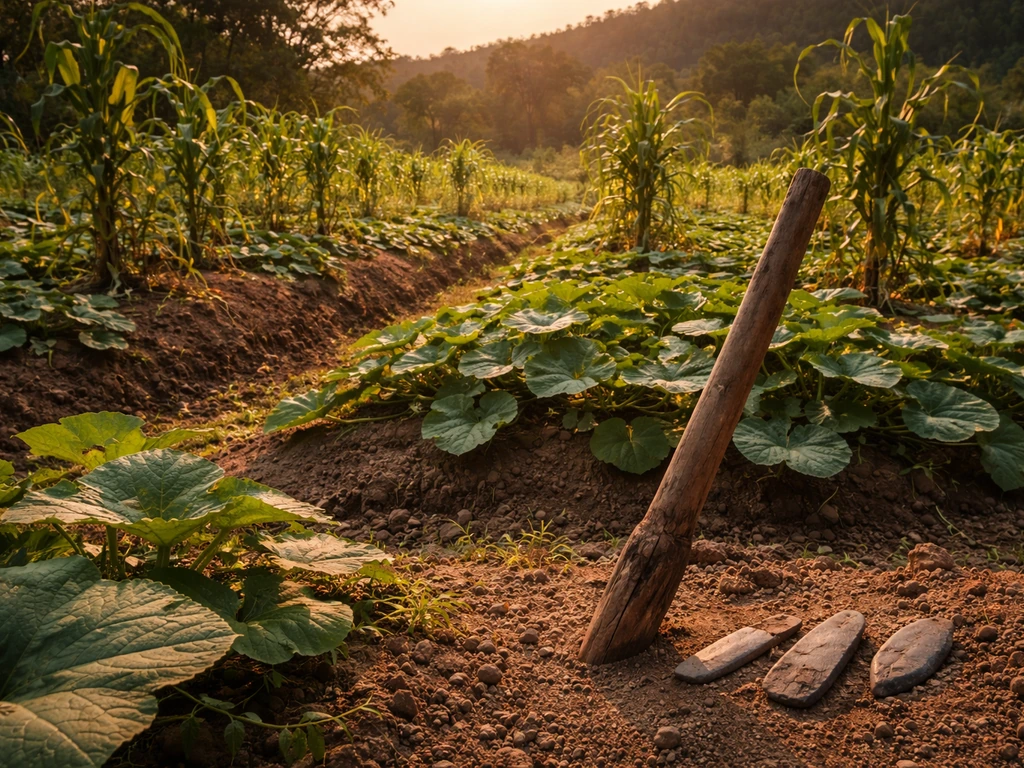
The most important tool in the Mayan farmer's hand was the digging stick, called a coa in the regional indigenous tradition. This was a long wooden pole, often hardened at the tip by fire or tipped with a sharpened stone, and it did double duty. First it was used to loosen and till small patches of soil. Then it was used to bore individual planting holes in a grid pattern across the field.
A Mayan farmer would work a milpa field by poking holes roughly a foot apart, dropping in a few maize kernels, then covering. Beans and squash seed went in nearby holes a few days later. The whole process was fast, low-disturbance, and required no tillage beyond those individual holes.
For heavier land-clearing work, stone axes made from basaltic rock were the primary tool. These were hafted axes used to fell trees before the dry-season burn. After burning, the soil was loose enough that the digging stick alone could handle planting. Stone knives and blade tools were also part of the standard kit, used for cutting back brush, trimming plant material, and general field tasks. The overall toolkit for land prep and planting was small: an axe to clear, a digging stick to plant, a knife to cut.
Tools for soil, water management, and irrigation
This is where Mayan agriculture gets genuinely impressive. The hand tools were simple, but the landscape engineering was not. In upland areas, Maya farmers built stone-faced terraces on hillsides, with furrows running parallel to the slope so rainfall would slow down rather than sheet off and carry topsoil with it. In lowland wetlands they did the opposite: they dug canals and piled the excavated soil up into long raised planting beds. Those raised fields kept crop roots above seasonal flooding while the canals between them drained excess water and, over time, filled with nutrient-rich sediment that could be scooped back onto the beds.
The digging tools for canal and terrace construction were almost certainly the same digging sticks used for planting, scaled up with larger wooden shovels or pointed poles for moving earth. Stone scrapers would have helped shape canal edges. The real infrastructure here was labor and planning, not specialized machinery. Groups of farmers working together over seasons built earthworks that lasted centuries. That communal investment in permanent field systems is what archaeologists call 'landesque capital,' and it is exactly the same reasoning behind building raised beds or swales on a modern homestead.
Weeding, harvesting, and post-harvest processing
Weeding and crop maintenance
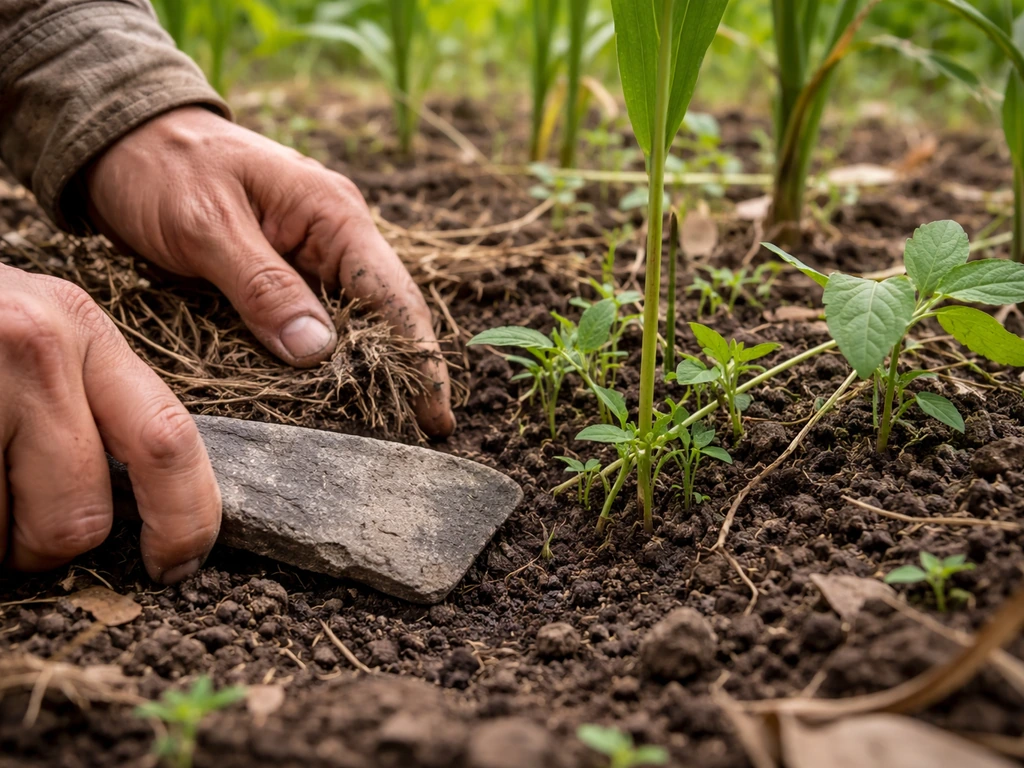
Between planting and harvest, the main field task was weeding. Stone scrapers and blade tools would have been used to cut weeds at or just below soil level, similar to the action of a modern hoe or collinear weeder. In milpa systems, the dense planting of maize, beans, and squash together, the classic Three Sisters combination, also acted as a natural weed suppressant. The squash leaves covered the ground and blocked light. Beans fixed nitrogen and climbed the maize stalks. Maize provided the vertical structure. The companion planting itself reduced how much hand-weeding was needed. Cover crops can also suppress weeds and protect your soil between growing seasons, which is why many farmers choose them hand-weeding.
Harvesting
Maize ears were twisted or snapped off the stalk by hand, which is still how most small-scale corn is harvested today. Stone knives and blades handled cutting squash from vines and separating bean pods. Harvested material went straight into woven baskets, which were carried using a tumpline, a strap looped across the forehead to distribute the load down the spine. Ethnoarchaeological work in the Puuc region of Yucatan documents milperos carrying maize ears in tumpline baskets from field to storage, a practice that connects directly back to ancient methods.
Post-harvest processing
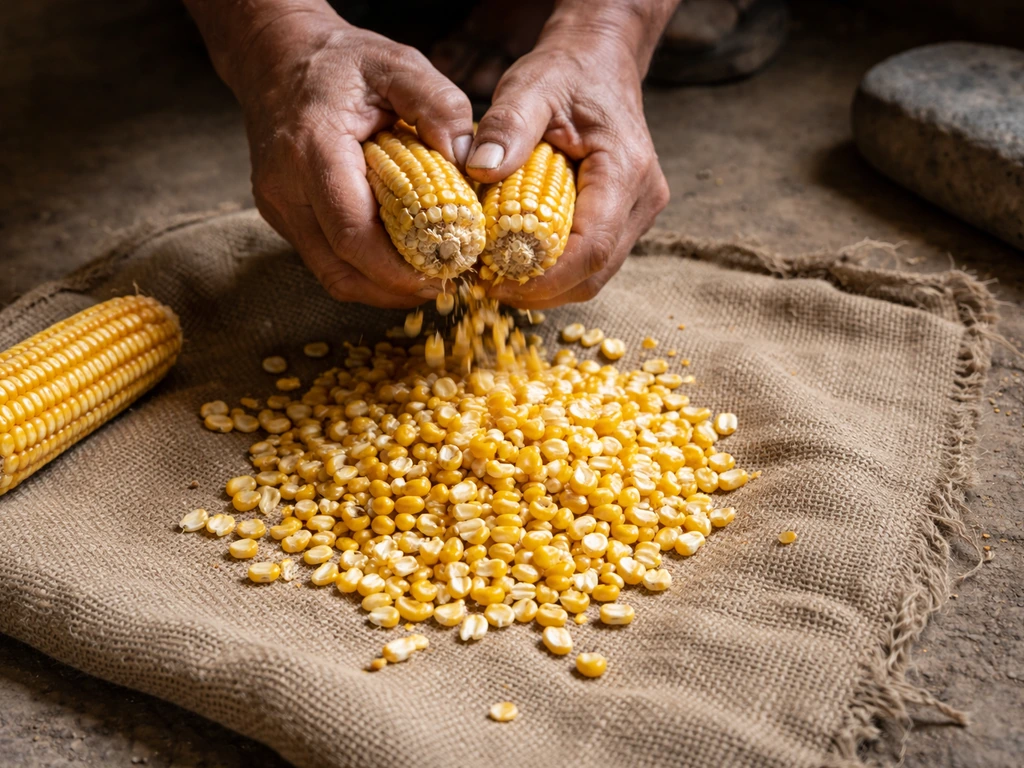
After harvest, maize went through two key processing steps before it was stored or eaten: shelling and grinding. Shelling was done by hand, rubbing dried ears against each other or over a rough surface to knock off the kernels. The Puuc region ethnoarchaeological accounts describe farmers spending a full day shelling seed before planting season. Once shelled, maize kernels were ground on a metate, a flat or slightly concave stone slab, using a mano, a handheld grinding stone.
The University of Florida's archaeological analysis confirms that plant residues including maize have been recovered directly from metate surfaces, so we know exactly what these tools were used for. Squash seeds were dried and stored; beans were threshed by hand or with a simple stick.
Crop support systems: mulch, staking, and trellises
The Mayan milpa system was its own built-in support structure. Maize stalks served as natural poles for climbing beans. That eliminated any need for separate staking or trellis materials. Squash sprawled across the ground and provided living mulch, keeping moisture in and soil temperature stable. Burned plant material from the slash-and-burn phase added a layer of organic matter (essentially a forced mulch-and-fertilizer application) before planting began. Some people ask whether killing animals is necessary for this kind of planting, but the evidence and practices described here focus on soil and water management rather than animal harm do farmers kill animals to grow plants.
In raised-field systems, the nutrient-rich canal sediment scooped back onto beds acted as a combined mulch and fertilizer top-dressing. There is no archaeological evidence of elaborate trellis construction beyond the maize-as-pole system, which makes sense: in a labor-constrained agricultural society, using the crops themselves as infrastructure is elegant and practical. The lesson for modern gardeners is the same one that makes Three Sisters planting popular today: let your crops do some of the structural work for you.
How to replicate Mayan-style farming at home
The good news is that every functional category of Mayan farming tool has a direct modern equivalent, and most of them are inexpensive. Here is how to map the ancient system onto a home garden or small homestead. If you are curious how did humans learn to grow crops in the first place, start by looking at the combination of digging, planting in workable patterns, and shaping water flow that Mayan farmers mastered.
| Mayan Tool / Technique | Function | Modern Equivalent |
|---|---|---|
| Digging stick (coa) | Loosen soil, bore planting holes | Digging bar, pointed hoe, or hand dibber |
| Stone axe | Fell trees, clear land | Hatchet, pruning saw, or brush axe |
| Stone scraper / blade | Weed, cut brush, harvest | Collinear hoe, harvest knife, or pruner |
| Woven tumpline basket | Carry and store harvested crops | Garden trug, harvest basket, or 5-gallon bucket |
| Mano and metate | Shell and grind dried maize | Hand-crank grain mill or countertop grain grinder |
| Raised field system | Elevate roots above water table, manage drainage | Raised beds with pathways as drainage channels |
| Canal / ditch network | Direct and drain excess water | Swales, French drains, or simple trenched rows |
| Terrace / furrow | Slow runoff on slopes, retain moisture | Keyline beds, contour rows, or simple berm-and-swale |
| Three Sisters planting | Natural trellis, weed suppression, soil enrichment | Three Sisters companion planting (same method, still works) |
Start with the digging bar and a good hoe
If you are setting up a milpa-inspired garden from scratch, a digging bar is the closest thing to a heavy-duty digging stick you can buy. It is a steel bar, typically 5 to 6 feet long and 15 to 20 pounds, that you use to break up compacted soil and punch holes for transplants or direct-sown seed. Pair it with a collinear hoe or a Warren hoe for weeding and you have covered the core functions of the entire Mayan planting toolkit. A hand dibber (a short pointed wooden or metal tool) replicates the fine-scale hole-poking for seed planting in already-loose soil.
Build your water management infrastructure first
The Maya invested serious effort in earthworks before they planted anything. That sequencing matters. On a slope, lay out your beds on contour so runoff slows and soaks in rather than rushing downhill. A simple A-frame level built from scrap lumber costs almost nothing and lets you find the contour accurately.
In low-lying or wet areas, build raised beds at least 12 inches tall and cut shallow drainage trenches between them. Those raised beds and drainage trenches also create farmland that can be used to grow crops even in wet or flood-prone areas. Those trenches do exactly what Mayan canals did: they carry away excess water during wet periods and can be scraped out seasonally to refresh the beds with accumulated organic material from the bottom.
Invest in a grain mill if you grow maize
If you are actually growing dried maize for flour or masa, a hand-crank grain mill is the non-negotiable modern metate. Good cast-iron hand mills like the Country Living Mill or the Wonder Junior start around $200 to $400 and will process dried corn into coarse meal or fine flour depending on your stone gap setting. That is the one tool where the ancient function does not have a cheap substitute. Shelling dried corn by hand is still perfectly doable the same way Mayan farmers did it, rubbing ears together over a bucket until the kernels fall off.
Plant Three Sisters for built-in crop support
The most directly replicable piece of Mayan farming practice costs nothing extra. Plant maize first, let it get 6 to 8 inches tall, then plant pole beans at the base of each stalk and winter squash in between the clusters. The maize stalks support the beans, the beans fix nitrogen, and the squash covers the ground. You get three crops in the same footprint, natural weed suppression, and a self-supporting structure without a single trellis post. This works in any garden bigger than about 100 square feet and the yield per square foot is genuinely competitive with monoculture beds.
The broader takeaway from studying Mayan farming tools is not that the tools themselves were exotic. They were not. What made Mayan agriculture productive was the combination of simple, well-chosen hand tools with deliberate, long-term landscape management. That same combination, a lean toolkit plus smart earthwork and companion planting, is exactly what makes a home garden or small homestead productive and resilient today. In practice, animals can support farmers by helping with tasks like composting and managing pests, which improves crop growth. The Maya figured that out over two thousand years ago, and the approach still holds up.
FAQ
What tools did Mayan farmers use to grow crops besides digging sticks and axes?
They also relied on harvesting and processing tools: stone knives/blade tools for cutting back brush and trimming plant material, and baskets plus a tumpline for transporting and storing harvests. For grain prep, they used a mano and metate combination, with shelling done by hand by rubbing dried ears.
Could I recreate Mayan-style planting without stone tools?
Yes, you can substitute modern steel tools for the same jobs. For example, use a digging bar or sturdy garden dibber to make consistent planting holes, and use a sharp hoe or collinear/Warren-style weeder for cutting weeds at or just below the soil surface.
How did Mayan farmers avoid plowing or heavy tillage, and what should I do in a modern garden?
In the milpa system they loosened soil locally by punching holes and placing seed, rather than turning the whole field. In a home garden this means using a dibber or digging tool to open planting spots, then relying on cover and companion planting to reduce weeds instead of frequent broad-area tilling.
What tools do I need to mimic Mayan water management if I do not have a raised-field or terracing project?
Start with simpler equivalents: contour planting on slopes (so runoff is slowed) and raised beds with shallow drainage trenches in wetter spots. You do not need full-scale canals to get the benefit, but you do need reliable drainage so roots stay oxygenated during rainy periods.
What is the simplest tool setup for a small milpa-inspired garden?
A practical minimal kit is one tool for punching holes (dibber or digging bar), one cutting tool for weeding (hoe-style), and one grain-processing tool if you plan to grow dried maize (hand mill). Harvest and handling are covered by basic baskets or crates, even if you do not use tumplines.
If I plant maize first and follow with beans and squash, when should I use which tool?
You mostly need the same digging tool for the initial maize holes. After maize reaches about 6 to 8 inches tall, you use small spot openings or hand hole-making to place beans at each stalk base, and you tuck squash seeds into the gaps between clusters without disturbing the maize roots.
Do the Mayan tools assume a specific soil type, and what if my soil is compacted clay?
The digging stick method works best when the soil can be loosened locally. If your soil is compacted clay, focus on targeted loosening in planting rows or holes first, then build soil structure over time with compost and mulching, rather than trying to replicate the system with repeated full tillage.
What tools did Mayan farmers use for weeding, and how does that translate to modern practice?
They likely used scrapers and blades to cut weeds near the soil surface. In modern terms, use a sharp hoe or collinear-style weeder to slice weeds just under the surface, and time it so weeds are small, because repeated cutting is usually more effective than trying to pull large rooted weeds.
How did Mayan farmers handle harvest without modern sacks or machinery?
They harvested by hand using knives/blades to separate plant parts, then carried product in woven baskets supported by a tumpline. If you are recreating this, plan for frequent small harvests and sturdy hand carry containers, since that reduces field damage compared with waiting too long.
What tools are necessary if I want to grind maize into masa or flour at home?
You will need a grinding setup equivalent to metate plus mano, at minimum a hand crank grain mill. If you skip that step and only shell by hand, you can still eat whole kernels, but true masa or fine corn flour requires proper grinding.
Is there a modern alternative to a metate that still works with whole kernels?
A good hand-crank mill can produce coarse meal or finer flour depending on settings, and it avoids the labor of stone grinding. Choose one that can handle dried corn well, and plan to sieve or adjust settings if you want a specific texture for cooking.
Do I need trellising tools for beans in a milpa-inspired bed?
Not in the classic setup described, because beans are planted at the base of maize to use maize stalks as poles. This means you can skip trellis materials, saving tools and labor, as long as you maintain adequate spacing so maize stalks are sturdy enough.
Next Article
Why Do Farmers Grow Crops? Real Reasons and How to Use Them
Practical reasons farmers grow crops and a simple framework to choose what to grow for food, savings, and resilience.