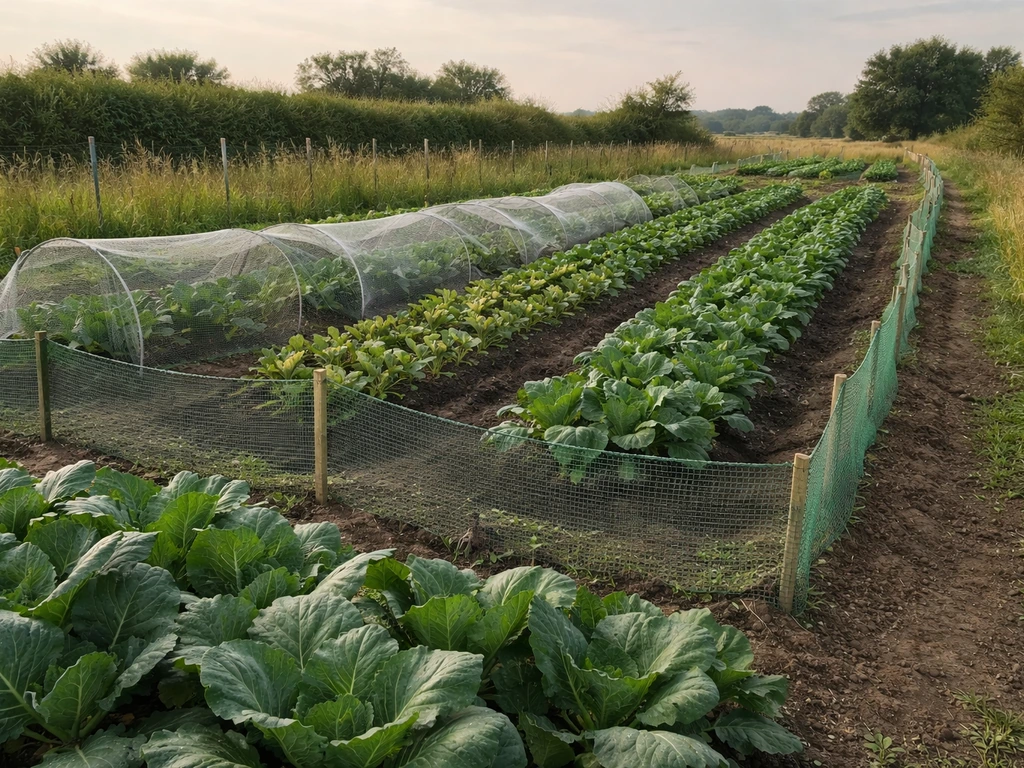
Farmers grow cover crops to keep their soil alive, protected, and productive between main cash crops. Farmers grow cover crops for the same reasons homesteaders do: they protect and improve the soil between main cash crops. Mayan farmers relied on simple hand tools and animal-powered implements to work the soil and establish crops suited to their growing conditions what tools did Mayan farmers use.
Why Do Farmers Grow Cover Crops? Benefits and How to Use

Marcus Hendrick
6 Jun 2026

The core benefits are real and measurable: less erosion, more water soaking in instead of running off, free nitrogen from legumes, fewer weeds, and soil that gets easier to work every year. Once you understand why these things matter at the farm scale, it becomes obvious why the same logic applies just as powerfully to a backyard raised bed or a half-acre homestead plot.
What cover crops actually are (and the simplest ways to use them)
The USDA defines cover crops as grasses, legumes, forbs, or other herbaceous plants established for seasonal cover and conservation purposes. In plain terms, they are plants you grow not to eat or sell directly, but to protect and improve the ground while your main crop is not in the field.
Humans have learned these crop-growing practices over thousands of years through experimentation with what kinds of plants improve soil and protect fields between harvests plants you grow not to eat or sell directly. University of Minnesota Extension describes the typical use case well: seed them in fall, let them grow through winter or early spring, then kill them before your main planting.
Some gardeners also wonder whether growers need to kill animals to grow plants, but cover cropping is about growing and terminating plants, not harming animals do farmers kill animals to grow plants. Simple enough.
There are a few common ways people use them. When you till a cover crop into the soil while it is still green, that is called a green manure crop (Colorado State University Extension's term). If you mow or roll it flat and plant directly into the residue, the dead material acts as a mulch layer. Penn State Extension categorizes these roles neatly: ground cover and mulch, green manure, nurse crop (protecting a slower-establishing main crop), and smother crop (smothering weeds with dense growth). You do not have to pick just one. A cereal rye you roll-crimp in spring can serve as mulch and weed suppressor at the same time.
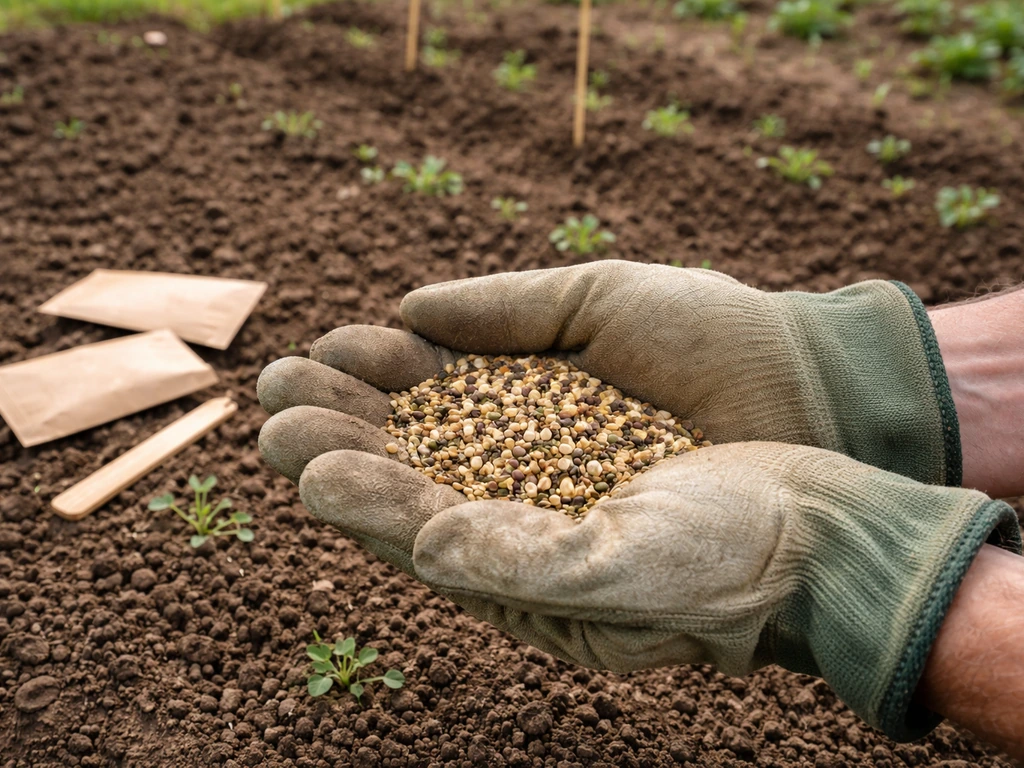
For home gardeners and homesteaders, the easiest entry point is a fall-seeded cover crop after your main vegetables come out. Broadcast cereal rye, crimson clover, or a simple mix into a cleared bed in late summer or early fall, let it grow until late spring, terminate it by mowing or tarping, wait two to three weeks for residue to start breaking down, then transplant into it. That single cycle gives you most of the benefits we are about to dig into.
Soil health is the real reason farmers do this
Everything else on this list flows from one core idea: cover crops feed and protect the soil biology that makes growing food possible. Bare soil left fallow through winter is not resting, it is degrading. Rain beats the surface, organic matter oxidizes, microbial communities shrink, and you lose the aggregate structure that makes soil easy to work and productive. Cover crops interrupt that cycle.
USDA Economic Research Service on-farm trials in the Soil Health Partnership showed measurable improvements in four key soil health indicators over just three to five years of cover cropping: active carbon, aggregate stability, soil respiration, and total soil organic matter. That is not a lifetime. Three to five years is a realistic homestead timeline, not some distant agricultural horizon. A Pacific Northwest National Laboratory meta-analysis confirmed that cover cropping increases mineralizable carbon and mineralizable nitrogen in the soil, which means more food for soil microbes and more nutrients cycling into plant-available forms.
If you want to track your own progress, the tools exist. ATTRA lists soil organic matter testing, active organic matter, soil respiration, and aggregate stability as the key indicators to watch. SARE describes a simple DIY 'slake test' where you drop a dried soil clump into water and watch whether it holds together or falls apart. Healthy aggregated soil holds its structure. Degraded soil melts. It takes about five minutes and costs nothing. Run it before you start cover cropping, then again two years in. You will see a difference.
Erosion control and water infiltration: two problems, one solution
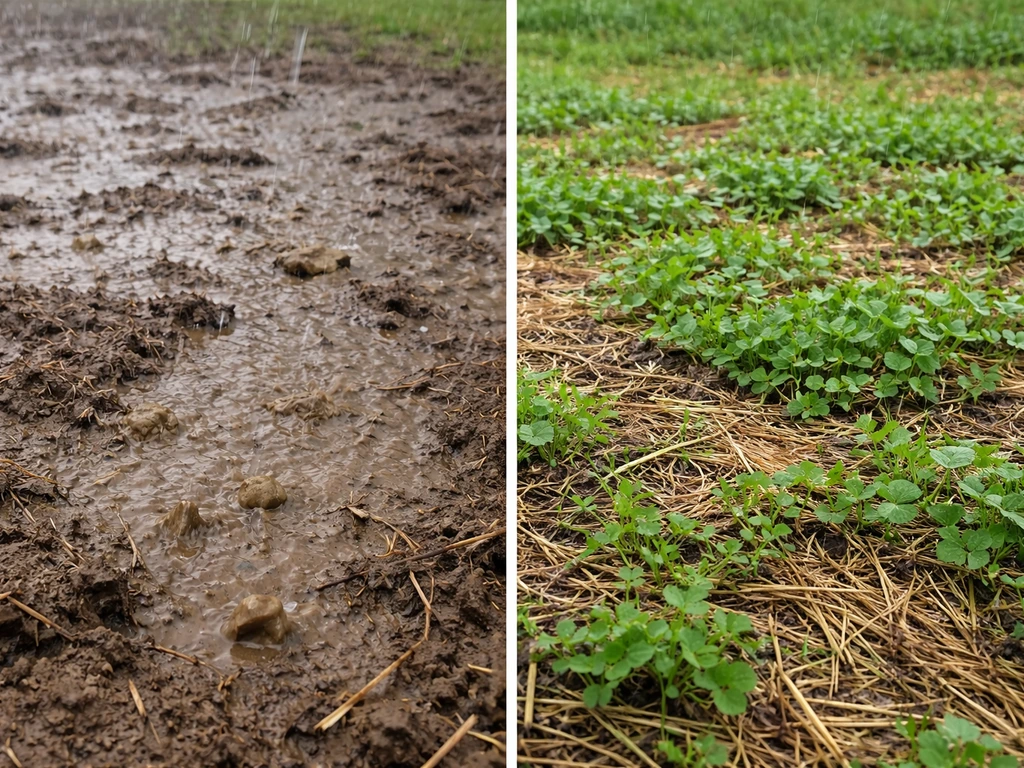
Exposed soil is soil in trouble. Rain hits bare ground and does two damaging things: it dislodges soil particles and carries them away (erosion), and it seals the surface so water runs off instead of soaking in. A living cover crop breaks up raindrop impact with its canopy, and its roots open channels down through the soil. After termination, surface residue keeps doing the protective work.
A 2025 global meta-analysis published in ScienceDirect found that cover crop management can enhance soil porosity, infiltration, and aggregate stability, with the size of the effect depending on tillage approach and how residue is managed. A separate meta-analysis covering 117 studies found that cover crops can improve precipitation storage efficiency and soil water at the time the next crop is planted. That last point matters a lot if you garden in an area with dry spells between rain events. Better infiltration means more of each rain gets stored where roots can reach it.
For a homestead context, think about a garden bed that puddles after rain or dries out and cracks in summer. Both symptoms point to poor soil structure. Two or three seasons of cover cropping, combined with minimal disturbance at planting, is one of the most direct fixes available. You are not adding anything exotic, you are letting plant roots and soil biology rebuild the pore structure that makes water management work.
Nitrogen fixation and nutrient cycling: getting more from your soil
This is where legume cover crops, think crimson clover, hairy vetch, field peas, or winter lentils, earn their reputation. Legumes form a partnership with rhizobia bacteria in the soil. The bacteria colonize the plant's roots, fix atmospheric nitrogen into forms the plant can use, and when the cover crop is terminated and decomposes, that nitrogen becomes available to the next crop.
Colorado State University Extension explains that inoculating legume seed with commercially prepared rhizobia is the way to kick-start this partnership, especially if you have not grown that legume family in that spot in the past three years. Penn State Extension recommends inoculation any time the legume has been absent for three or more years, or whenever you are growing a high-value crop that you want to reliably feed.
The nitrogen contribution is real, but the exact amount depends on species, growing season length, biomass produced, and how well the rhizobia partnership is established. Matching the right inoculant to your specific legume species matters, using a clover inoculant on hairy vetch will not work as well as using the correct vetch inoculant. Get that detail right and a well-grown hairy vetch stand can contribute meaningful nitrogen to a following vegetable crop.
Non-legume cover crops like cereal rye do not fix nitrogen, but they serve a different nutrient function: they scavenge leftover nitrogen and other nutrients from the soil profile before rain leaches them away. A global meta-analysis in PubMed analyzing 238 observations from 28 studies found cover crops reduce nitrate leaching in agroecosystems overall.
In particular, a USDA ARS global meta-analysis compares cover crops versus no-cover controls across soil, climate, and management factors to quantify effects on nitrate leaching in agroecosystems [cover crops reduce nitrate leaching in agroecosystems overall](https://www. ars. usda. gov/ARSUserFiles/21904/Others%20PDFs/J%20Environ%20Qual%2047p1400.
pdf). A separate meta-analysis found that grasses and brassicas tend to be stronger nitrate scavengers than legumes, while legumes contribute more net nitrogen through fixation. The practical takeaway: if your goal is to prevent nutrient loss over winter, a grass or brassica cover is your best bet. If your goal is to add nitrogen for a spring crop, plant legumes and inoculate them.
One nuance worth knowing: Aarhus University research found that grouping cover crops by broad category (grass, legume, brassica) can be misleading because species identity, meaning the actual specific plant you grow, explained a large share of variation in nitrogen uptake and nitrogen losses. Species choice matters more than category. Cereal rye is not interchangeable with oats. Crimson clover is not the same as hairy vetch. When in doubt, start with cereal rye or hairy vetch. Both are well-studied, widely available, winter-hardy in most climates, and produce enough biomass to make a measurable difference.
Weed suppression and disease management through living soil
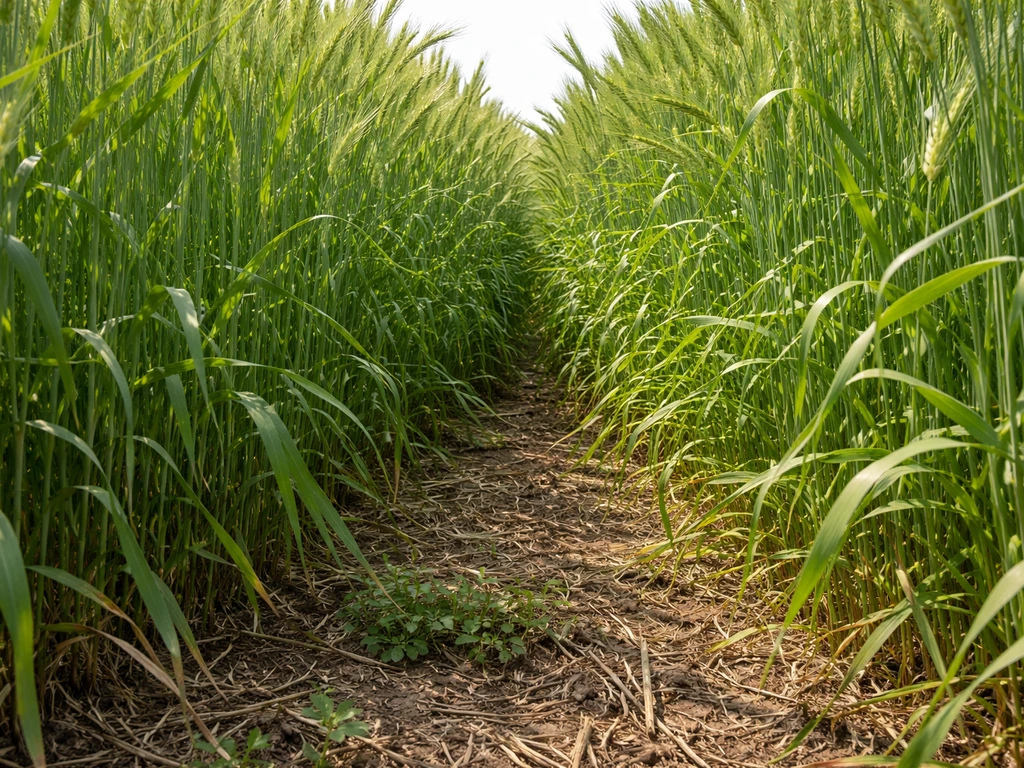
A dense cover crop canopy shades out germinating weeds. After termination, the surface residue continues that job for weeks. Cereal rye is the standout here. It grows fast, produces a lot of biomass, and contains benzoxazinoid compounds that are released into the soil as residue breaks down, compounds that suppress germination of certain weed species. USDA ARS research links the persistence of this suppression to the period of elevated benzoxazinoid activity after termination.
That said, keep this in perspective. Iowa State Extension and UW-Madison both note that in most field conditions, rye's weed suppression is primarily driven by competition for light and soil resources during growth and by the physical residue layer after termination. The allelopathic effect on many cash crops is modest under real field conditions. The residue mulch is doing most of the heavy lifting, and that effect is significant. An NDSU study on fall-seeded cover crops found that termination method directly affected how much weed biomass appeared in the subsequent crop, which means how you kill the cover crop is just as important as which one you grow.
On the disease and pest side, the benefit is less direct but still real. Cover crops feed soil biology, and a diverse, active soil microbiome is a more resilient one. PMC-published research found cover crop techniques can alter soil microbiome abundance and diversity. More diverse soil communities tend to suppress specific soilborne pathogens through competition and predation. This is not a silver bullet for fungal disease or pest pressure, but building soil biology over multiple seasons creates conditions where problems become less severe and less frequent.
Better soil structure means deeper roots and better yields
Soil structure is about how individual soil particles clump together into aggregates with pores between them. Good structure means roots can penetrate deeply, oxygen reaches soil organisms, and water moves efficiently. Research published in the journal Soil found that cover crops improve macroporosity and aggregate stability, but the magnitude of the effect depends heavily on root morphology and the specific species or mix you choose. Fibrous grass roots create a different channel network than deep taproots. Mixing species can give you both.
A 2024 global synthesis covering 104 articles and 1,027 records quantified how cover crops influence subsequent main crop yields. The picture is positive overall, though the effect varies by context, which is honest and useful information. For home gardeners, the structural improvement translates to practical wins: transplants root in faster, carrots and parsnips grow straighter in loose ground, and water-stressed plants recover more quickly when soil can hold and release moisture well. These are not abstract statistics. They show up in your harvest.
When cover crops are worth it (and when they are not)
Cover crops are not free. Seed costs money, termination takes time, and getting timing wrong creates real problems. A Springer meta-analysis on drylands found that in water-limited environments, cover crops produced positive outcomes for soil mineral nitrogen in 52% of cases but actually reduced soil water in many scenarios where winter rainfall was low and cover crop water use competed with the following crop. In a dryland context, that is a significant trade-off. If you are in a dry climate, growing a winter cover through a drought year could cost you spring soil moisture. Choose drought-tolerant, low-biomass options or shorten the growing window.
Termination timing is the other major risk. Iowa State Extension is direct about this: an improperly terminated cover crop can become a troublesome weed. Do not let cover crops set seed. If you mow too early, the plant regrows.
If you mow too late, it produces seed that becomes next season's weed problem. NC State Extension ties proper termination to crop phenology, meaning you need to time it to the plant's growth stage, not just the calendar. Penn State Extension warns that roller-crimping before the cover crop reaches its kill-effective growth stage leads to regrowth. NC State also defines 'volunteer cover crops,' those are plants coming up in future seasons from seeds you let set inadvertently.
Avoid this by terminating before flowering whenever possible.
For home garden beds, the three most reliable termination methods are mowing followed by tarping for two to three weeks, rolling or crimping the biomass flat (most effective at or after flowering for small grains), and incorporating with a broadfork or shallow tillage if structure is not yet built. Each has a place depending on your setup and goals.
Matching cover crop to your actual goal
| Your goal | Best cover crop type | Species to start with | Key timing note |
|---|---|---|---|
| Add nitrogen for spring crop | Legume | Hairy vetch or crimson clover (inoculated) | Terminate before or at early flowering |
| Prevent nutrient leaching over winter | Grass or brassica | Cereal rye or daikon radish | Seed in late summer to early fall |
| Suppress spring weeds | High-biomass grass | Cereal rye | Terminate at or just after heading, before seed set |
| Improve soil structure and drainage | Grass or mixed | Cereal rye plus crimson clover mix | Allow full growing season, terminate spring |
| Control erosion on bare slopes | Fast-establishing grass | Annual ryegrass or oats | Seed immediately after harvest |
| Dryland or water-limited beds | Low-biomass option | Field peas or short-season oats | Terminate early spring before moisture draw peaks |
A simple starter plan you can act on today
You do not need to overthink this. Here is a practical starting point for a backyard or small homestead plot, designed around what is most likely to succeed and give you visible results within one season. Animals can also play a role on farms, helping manage cover crop growth through grazing or manure that feeds the soil and supports better crop yields cover crops.
- After your last main crop harvest in late summer or early fall, clear plant debris and lightly rake the bed surface.
- Broadcast cereal rye seed at roughly 2 to 3 ounces per 100 square feet, or use a cereal rye plus hairy vetch mix if you want both weed suppression and nitrogen. Rake seed in lightly or roll it in with your foot.
- Let it grow through fall and winter. It will go semi-dormant in cold weather and resume fast in early spring.
- In mid to late spring, when rye is around knee height or just starting to head (and before it flowers if possible), mow it to the ground or lay it flat. Tarp the area with a black silage tarp or heavy cardboard for two to three weeks.
- Remove the tarp. Wait until residue is starting to break down and loses its green color. Transplant your summer vegetables directly into the residue layer without digging, or rake residue aside for direct seeding.
- Watch for any regrowth and mow or pull it immediately. If the cover crop set seed before you terminated, expect some volunteers and pull them young.
- After two or three seasons, run a slake test on your soil before and after winter. The difference in aggregate stability will tell you whether the system is working.
Start with one bed or one section of your garden. The goal in the first year is to get the timing right and understand how your specific cover crop behaves in your climate. Once you have done it once, the second year becomes routine. The soil improvements compound quietly in the background while you focus on your main crops, and that is exactly the point. Using cover crops can turn fallow space into farmland that can be used to grow crops by improving soil readiness for your next planting.
FAQ
Will cover crops always reduce weeds in my garden, or can they make weed problems worse?
They usually help, but only if you terminate at the right stage. Letting a cover crop flower or set seed can create volunteer cover that behaves like a weed next season. Also, rye’s residue helps most when it stays on the surface long enough to form a mulch layer, so rushing termination and immediately planting into bare, thin residue can reduce the effect.
Do I need to kill the cover crop, or can I just leave it living under my next crop?
For most home garden and small-field situations, you want to terminate so it does not compete with the main crop for light, water, and nutrients. “Living mulch” systems do exist, but they require specific main crop choices and management timing. If you are not running a designed living-mulch plan, plan on mowing, crimping, or tarping before the main crop goes in.
What’s the best way to decide between a legume cover crop and a grass cover crop?
Use legumes when your goal is nitrogen addition for the next crop, especially if you can inoculate correctly. Use grasses (and many brassicas) when your priority is scavenging leftover nitrogen, protecting soil over winter, and reducing nitrate leaching. If you are unsure, start with cereal rye for winter protection and simple management, then add legumes later as you learn your timing.
Is inoculating legume seed always necessary?
Not always, but it is commonly needed when the legume family has not been grown there recently (roughly three years or more), when conditions are new to that species, or when you want reliable performance for a high-value crop. Inoculants are species-specific, so use the product matched to your exact legume, not a generic “nitrogen fixer.”
How long should I wait after terminating the cover crop before planting?
A common home-garden rhythm is about two to three weeks, but it depends on temperature, moisture, and termination method. Green, thick growth that is rolled or mowed may take longer to break down than dry residue. If you see obvious intact stems or a mat that feels dry and carbon-heavy, wait longer or slightly increase residue contact with soil (without heavy tillage) to improve soil contact.
Can cover crops backfire in dry climates by stealing spring soil moisture?
Yes. In water-limited regions, a winter cover can reduce available soil water for the next crop, especially in years with low winter rainfall. The practical fix is choosing drought-tolerant species, keeping biomass lower (by shortening the growing window or using less aggressive mixes), and terminating earlier so the cover does not keep transpiring into the planting window.
What termination method is “best” for small gardens: mowing, rolling/crimping, or tarping?
There is no single best method. Mowing plus tarping works well when you can apply tarping long enough to darken the mulch and stop regrowth. Rolling or crimping works best when the cover crop is at a kill-effective stage, otherwise you may get regrowth. If your soil is compacted or structure is poor, shallow disturbance with a broadfork or shallow tillage can help residue contact, but avoid over-tilling if your goal is to build soil structure over time.
How can I tell if my soil is improving before I get measurable yield changes?
Look for practical early signs, like improved water infiltration (less puddling), easier penetration with a fork or trowel, and less surface crusting after rain. If you want a simple test, a slake test can show whether soil aggregates are holding together. These observations can change in a season, while bigger yield shifts often take multiple cycles.
Will cover crops work if my soil is compacted or full of weeds?
Yes, but manage expectations and start small. Compaction improves more reliably when you also increase root growth paths, which means choosing species with good root morphology and avoiding heavy tillage that resets the problem. For weeds, the key is terminating before seed set and ensuring residue thickness is enough to suppress germination. Consider starting with one bed to learn timing and residue behavior in your specific conditions.
Do cover crop benefits require tilling them into the soil?
No. Cover crops can work well when they are terminated and left as surface residue, which protects the soil and continues feeding soil organisms as the residue breaks down. Tilling can sometimes speed decomposition and improve seed-to-soil contact, but it also disrupts soil structure, so many growers use minimal disturbance, then evaluate based on how your soil responds.
Are cover crop results guaranteed in three to five years?
They are measurable in many trials over that timeframe, but not guaranteed. Outcomes depend on species choice, termination timing, residue management, climate, and how much you disturb the soil. If you want progress, track at least one indicator consistently, like water infiltration or aggregation, and adjust your species and termination timing based on what you observe.
Next Article
Do Farmers Kill Animals to Grow Plants? The Real Reasons
No, farmers usually don’t kill animals to grow plants; crops use pest control, deterrence, and responsible wildlife mana