Rice farming spans an enormous range of technology, from farmers planting seedlings by hand in flooded paddies with zero mechanical inputs to fully automated operations using GPS-guided tractors, drone scouting, satellite yield monitoring, and computerized dryers. Globally, the honest answer is: it depends heavily on where you are and what scale you're farming. In high-income countries like the U. S.
How Much Technology Is Used to Grow Rice

Marcus Hendrick
10 Jun 2026
, Japan, and Australia, rice production is extremely mechanized and tech-driven. In much of South and Southeast Asia and sub-Saharan Africa, smallholder farmers still rely on manual labor for most steps. What's consistent across almost all rice farming worldwide is that at least one major technology shows up: irrigation. About 29% of all irrigated cropland globally is rice, and FAO data confirms that nearly half of the world's irrigated cereals is rice.
So even farmers who do everything else by hand are usually managing water with some kind of infrastructure.
Where tech shows up across the rice-growing process
Technology in rice farming isn't one thing. It's layered across every stage: land preparation, seed selection, planting, water management, crop protection, harvesting, drying, milling, and storage. Some stages are heavily mechanized almost everywhere. Others are still mostly manual in developing regions. Here's a quick map of where technology concentrates most.
| Stage | Low-tech approach | Modern tech approach | Global adoption level |
|---|---|---|---|
| Land prep | Hand tillage, oxen | Tractors, laser leveling | Partial to high in Asia; high in U.S./Australia |
| Seeding/transplanting | Hand broadcasting or transplanting | Mechanical transplanters, direct seeders | Low to medium in developing regions; high in industrialized |
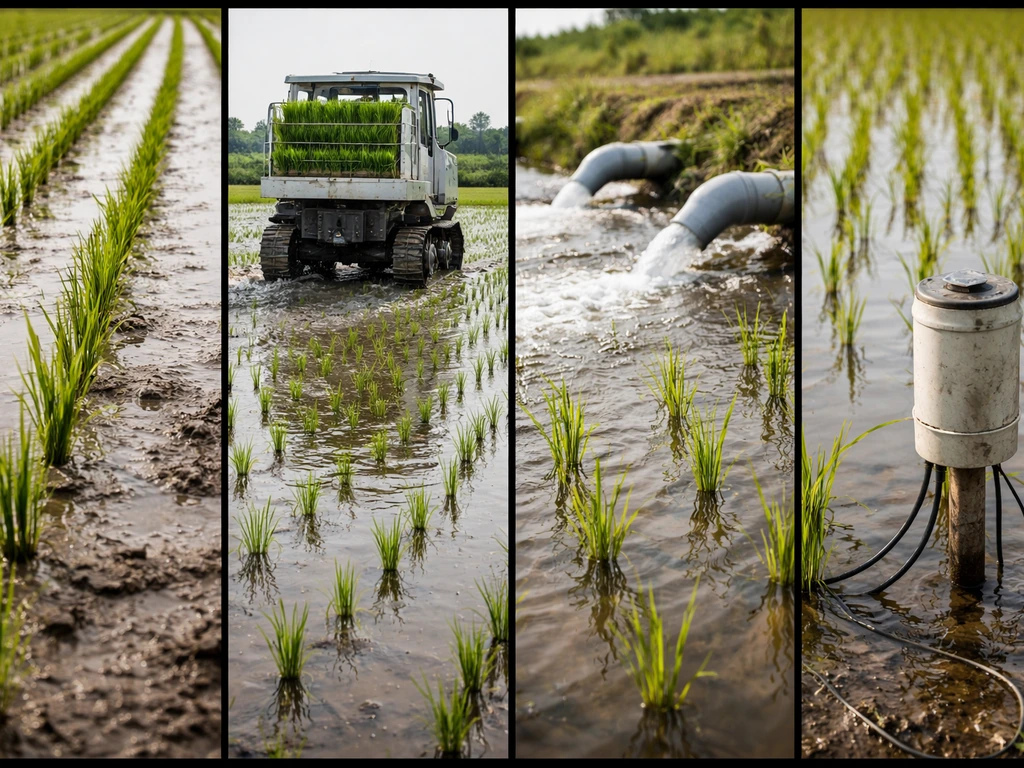
| Water management | Manual bunds and ditches | Electric pumps, sensors, drip/AWD systems | Variable; pumps very common, sensors still emerging |
| Crop protection | Hand spraying, manual scouting | Drone spraying, satellite monitoring, IPM apps | Low globally; high in China, Japan, U.S. |
| Harvesting | Sickles, hand threshing | Combine harvesters | Rising rapidly in India, China, Vietnam, Cambodia |
| Drying | Sun drying on mats/roads | Flatbed mechanical dryers | Still mostly manual in developing countries |
| Storage | Woven bags, open bins | Hermetic bags, silos, moisture meters | Low to medium among smallholders |
| Milling | Mortar and pestle, small hullers | Commercial rice mills | Mostly centralized in market-connected regions |
Low-tech methods that still dominate much of the world
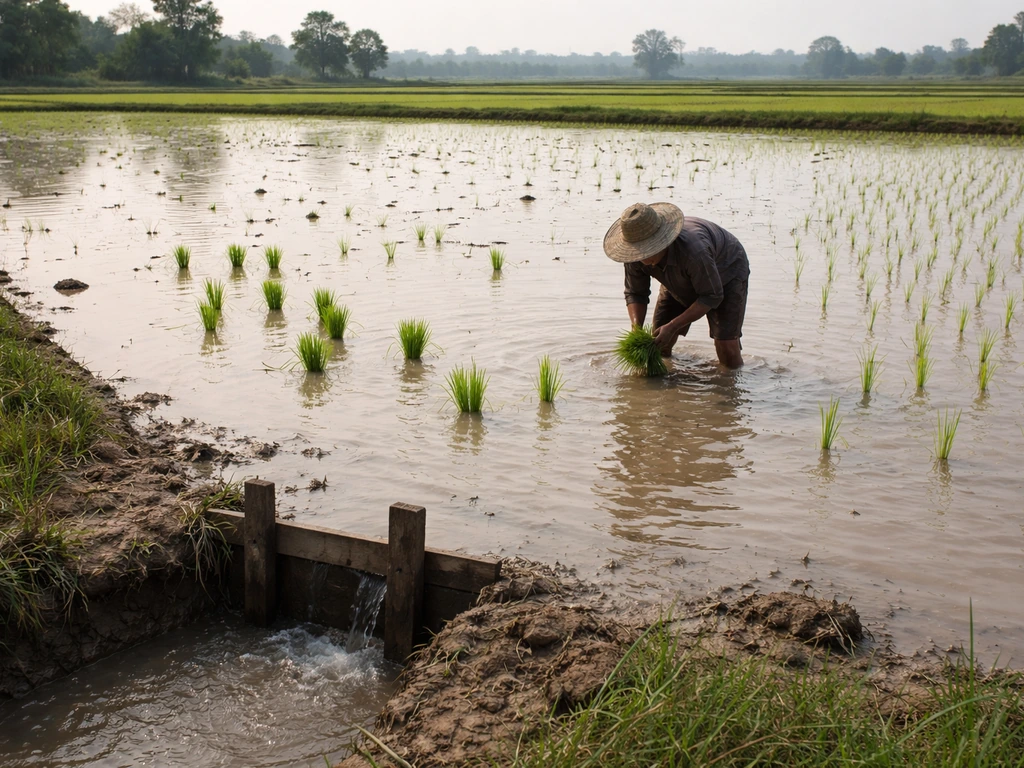
If you look at where most of the world's rice is grown, low-tech still wins by volume of farmers, even if not by tonnage. In developing countries across sub-Saharan Africa, South Asia, and parts of Southeast Asia, many pre-harvest and post-harvest operations including drying, dehulling, winnowing, and storage are done manually by smallholders. That's not a failure of those farmers. It's a reflection of capital access, infrastructure, and farm size. A 0.5-hectare paddy plot doesn't justify the cost of a combine harvester.
The baseline low-tech rice system looks like this: farmers flood a field using gravity-fed canals or rainfall, transplant seedlings by hand into puddled soil (or broadcast seed), manage weeds by hand weeding or water depth, and harvest with sickles. Threshing is done by hand or with a simple foot-powered thresher. Rice is then sun-dried on mats or tarps before storage in woven bags. This system works.
It produces food. And in many regions, it's the only economically viable approach. But it also carries risk: post-harvest losses from improper drying and storage can run anywhere from 10 to nearly 40 percent of the harvest, according to FAO data, with drying alone accounting for 1 to 5 percent and storage losses adding another 2 to 6 percent.
Modern seeds, fertilizer, and machinery: the first wave of tech adoption
The most universal 'technology upgrade' in rice farming globally has been high-yielding seed varieties. Modern semi-dwarf varieties developed since the Green Revolution respond better to nitrogen inputs and resist lodging (falling over), which makes fertilizer worthwhile. Corn yields depend on nitrogen rate, but the right amount depends on soil tests, target yield, and local recommendations nitrogen inputs. Without an improved variety, heavy fertilization on traditional tall varieties mostly produces more straw, not more grain. This seed-plus-fertilizer combination is now nearly ubiquitous even in regions that mechanize very little else.
The next rung up is mechanization for land prep and harvesting. Tractor-based tillage has spread widely across Asia over the past 30 years, largely replacing oxen for puddling and field prep. Combine harvesters are increasingly common in major rice-producing countries including India, China, Thailand, Vietnam, and even Cambodia, where they integrate cutting, threshing, cleaning, and bagging into one pass. For smallholders in Nigeria, controlled experiments show that mechanized harvesting and threshing reduce grain losses and have a positive business case even at small scale, because avoided food losses offset the cost of mechanization.
Mechanical transplanting is a newer piece of the puzzle. Small-scale mechanical transplanters working in non-puddled soils have been shown to reduce fuel use, labor requirements, and even irrigation water needed for establishment compared to the traditional puddled transplanting baseline. That's a meaningful triple benefit for small farmers who are trying to cut costs and conserve water simultaneously.
Water management technology: from gravity canals to soil moisture sensors
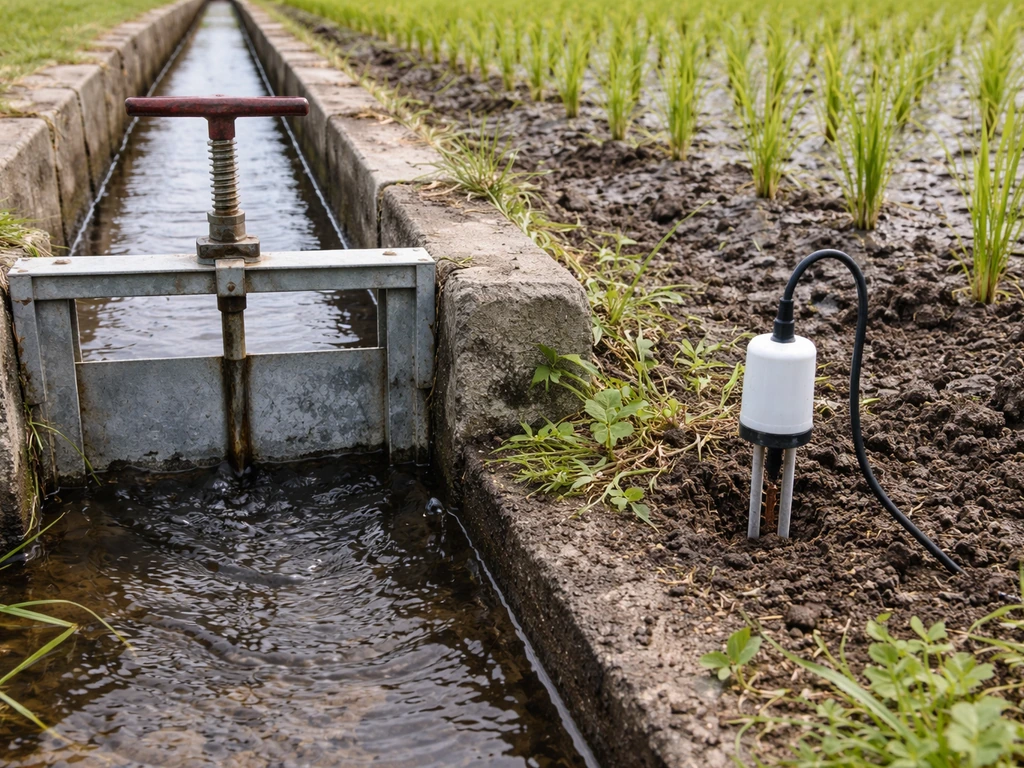
Water is where rice farming and technology are most deeply intertwined. Rice occupies about 29% of all irrigated crop area worldwide, and the infrastructure behind that irrigation ranges from ancient gravity-fed canals to modern electric pumps to satellite-informed sensor networks. In the U.S., rice has the largest share of acres irrigated by gravity systems of any major crop, meaning that even in a high-tech farming country, the water delivery method for rice is often relatively simple: flood the field and manage depth with levees and gates.
In regions without reliable gravity water sources, electric and diesel pumps are the critical technology. Pump-irrigated rice now covers huge swaths of Bangladesh, India, and sub-Saharan Africa. These pumps are often smallholder-owned or rented, not high-tech by Silicon Valley standards, but they're the difference between one crop per year and two or three. Laser land leveling is a step further up: GPS-guided land grading that levels a field to within a few centimeters. A study in Pakistan Punjab found that laser land leveling increased rice yields and reduced irrigation water use significantly, because water distributes evenly across a flat field rather than pooling in low spots and leaving high spots under-watered.
At the leading edge, soil moisture sensors and alternate wetting and drying (AWD) systems are starting to show up on progressive farms. AWD involves letting the field dry partially between irrigations rather than keeping it continuously flooded. When managed with simple tube gauges or electronic sensors, AWD can cut water use by 15 to 30 percent with minimal yield penalty. This is one of the most impactful low-cost technology options available for water-stressed rice farmers today.
Precision agriculture: GPS, drones, satellites, and variable-rate inputs
Precision agriculture in rice is real and growing fast, but it's concentrated in wealthy farming countries and large commercial operations. In the U.S., USDA data shows that automated GPS guidance has been adopted on well over 50% of acreage for some crops, and rice is included in that trend. GPS-guided tractors reduce overlap during field operations, cutting fuel and input costs. Variable-rate technology (VRT) applies fertilizer or chemicals at different rates across a field based on soil maps or sensor data, rather than applying one flat rate everywhere.
Drone technology is advancing rapidly, especially in China and Japan, where regulatory frameworks allow commercial drone spraying over rice paddies. Drones cover ground quickly, apply pesticides or fertilizer with minimal human exposure, and can target problem areas identified by aerial imaging. UAV-based yield estimation, using vegetation indices and machine learning, can now estimate rice grain yield from imagery with meaningful accuracy, giving farmers early warning before harvest. Satellite data from platforms like Sentinel-2 is also used for within-field yield monitoring at scale.
For most of the world's rice farmers, though, precision ag is still aspirational. The cost of sensors, connectivity, and data interpretation puts it out of reach for a smallholder farming a few hectares in Myanmar or Nigeria. That gap is real, and worth acknowledging honestly.
Post-harvest and supply-chain tech: drying, storage, and milling
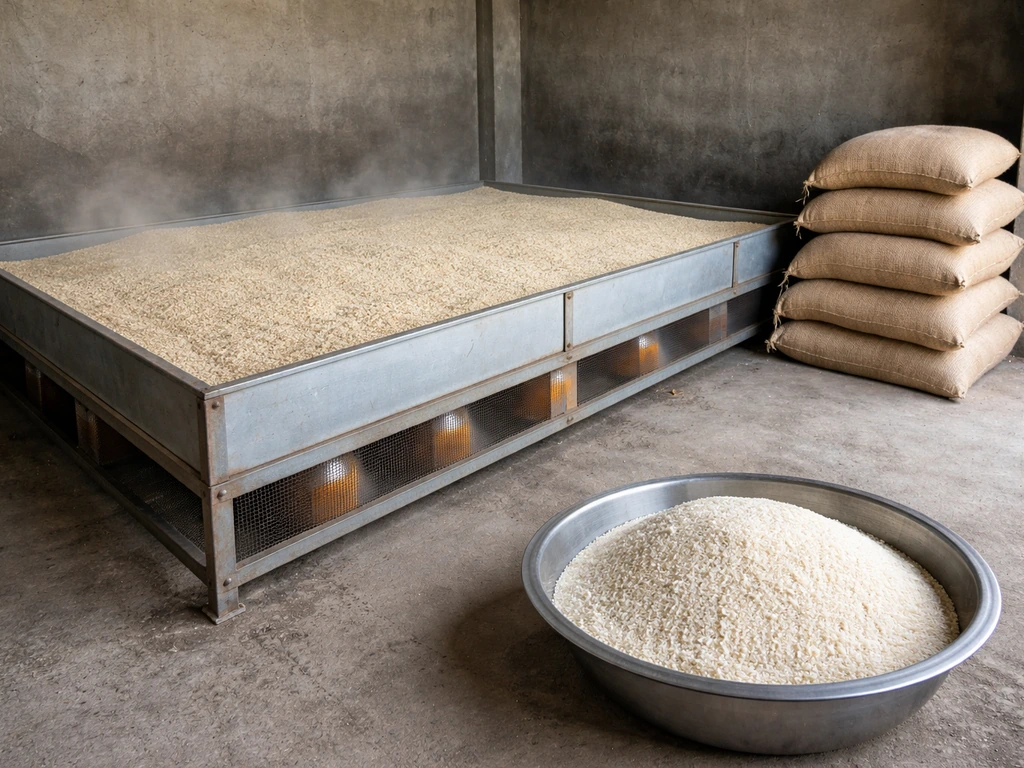
Post-harvest is where technology has some of the highest-leverage impacts on rice quality and food security, and also where its absence causes some of the most preventable losses. The 10 to 40 percent post-harvest loss range cited by FAO isn't mainly about insects or rodents eating grain in storage. A large share comes from moisture mismanagement during drying, which causes fissuring in the grain kernel that then breaks during milling, reducing the percentage of whole (head) rice in the final product.
Flatbed mechanical dryers address this directly. Research in Myanmar found that using a flatbed dryer and hermetic storage reduced grain discoloration by 3 to 4 percent and increased the head rice recovery ratio by 20 to 30 percent by weight, compared to lower-mechanization approaches. That's a massive quality improvement. Modeling work in China found that shifting from sun drying to mechanical drying, combined with better storage and transport, could cut total losses in the reaping-to-storage chain from 6.
Modeling in China suggests that increasing combine harvesting, bulk transportation, mechanical drying, and depot storage could reduce rice losses in the reaping-to-storage chain from 6. 9% to 2. 6% (as assumed in prior postharvest loss literature) [could cut total losses in the reaping-to-storage chain from 6. 9 percent to 2.
6 percent](https://www. mdpi. com/2071-1050/13/17/9627). 9 percent to 2.
6 percent.
Grain moisture meters are a relatively cheap technology that makes a big difference at the farm or dryer level. Modern dielectric moisture meters let farmers or dryer operators know exactly when rice has reached the safe moisture level for storage (typically around 14% moisture content), rather than guessing by feel. Storing wet rice leads to mold, discoloration, and breakage. Storing over-dried rice wastes energy and can also cause fissuring from re-absorption of ambient moisture.
For smallholders without access to commercial dryers or silos, hermetic storage bags (like Purdue Improved Crop Storage bags, or PICS bags) are one of the most accessible technologies available. These sealed bags cut off oxygen to stored grain, killing insects without chemicals, and they work for rice as well as many other crops. They're low-cost, reusable for multiple seasons, and require no electricity or infrastructure. If there's one technology upgrade I'd push every small-scale rice grower to make, it's this one.
How to apply this at home: practical tech levels for small plots
If you're growing rice at home for food security or self-sufficiency, you don't need drones or GPS tractors. But you do benefit from thinking deliberately about which technologies give you the most return at your scale. Here's how I'd break it down into practical levels.
Level 1: The absolute essentials (worth it for any plot size)
- Improved seed varieties: Buy certified high-yielding seed rather than saving grain from a mixed or unknown variety. This is the single highest-leverage input in rice farming.
- Basic soil test: A $15 to $20 soil test tells you your pH and nutrient levels. Rice prefers a pH of 5.5 to 6.5. Applying fertilizer without knowing your soil is guesswork.
- Simple water depth control: Even a small raised earthen bund with a simple gate or standpipe lets you manage flood depth precisely. This matters more than any other on-field variable for backyard paddy.
- A thermometer and calendar: Tracking degree days and planting/harvest timing is the lowest-cost 'technology' most home growers underuse.
Level 2: Worthwhile upgrades for serious home growers
- A grain moisture meter: If you're drying and storing your own rice, a basic moisture meter (under $30 for a handheld unit) tells you when to stop drying and when it's safe to seal in storage. Worth every cent.
- Hermetic storage bags or buckets: Food-grade sealed containers or PICS-type bags keep insects out of stored rice without chemicals. Game-changing for multi-month storage.
- An electric pump or gravity-fed tank: If you're not gravity-irrigating, a small submersible or centrifugal pump for plot irrigation opens up a lot of scheduling flexibility.
- Alternate wetting and drying management: This doesn't require sensors at home scale. A simple buried perforated tube (a 'field water tube') lets you see the water table depth. Refill when it drops to 15 cm below the surface. This alone can cut your irrigation water use by 20 to 30 percent.
Level 3: Skip at home scale (not worth the cost or complexity)
- GPS guidance and auto-steer: Irrelevant for a backyard plot or even a quarter-acre paddy.
- Drone spraying: Useful on acres, overkill on a home garden. A hand pump sprayer does the same job.
- Satellite yield monitoring: At home scale, walking the plot and observing panicle fill gives you all the yield data you need.
- Commercial flatbed dryers: Only make sense at scale. At home, spreading rice thinly on a screen in the sun with regular turning works well if you're drying promptly after harvest and watching your moisture.
The bigger picture here mirrors what you'd find when researching how other crops use technology at scale versus at home. If you are wondering how does corn grow video, the same idea applies: focus on the basics first, then add the right tools when they solve a specific problem how other crops use technology at scale versus at home. The technology gap between industrial rice farming and home rice growing is real, but most of the yield and quality benefits come from the basics done consistently: good seed, correct water management, and proper drying and storage. Get those right first. The fancy tools come later, if ever.
Rice is genuinely achievable for home growers and homesteaders, and the tech barrier is lower than you might think. You don't need to replicate a commercial rice operation. You need clean water, a sunny spot, improved seed, basic soil management, and a plan for drying what you harvest. Start there, and add tools only where they solve a specific problem you're actually running into. Bonemeal can help certain trees get a stronger start, but the amount depends on the tree type, the pot or soil size, and how long it has been in place.
FAQ
If I’m a smallholder, which single technology change usually gives the biggest overall payoff in rice farming?
Start with drying and storage control, not precision gadgets. A grain moisture meter plus hermetic storage (for example, PICS-style bags) helps prevent kernel cracking and mold, which directly improves head rice recovery and reduces preventable post-harvest loss.
Does more technology always mean higher rice yield?
Not necessarily. Yield gains depend on whether other inputs and management can match the technology. For instance, improved semi-dwarf varieties tend to work best when nitrogen is available and properly managed, and mechanization for harvesting only helps if grain is properly dried afterward.
What’s the most common reason “mechanized” rice still produces low quality grain?
Harvesting and drying often get disconnected in practice. If combine or threshing is used but drying timing or moisture targets are missed, you can still end up with fissuring and higher breakage during milling, which lowers whole-rice yield even when field losses are reduced.
How do I know when rice is ready for safe storage without guessing?
Use a moisture meter and aim for roughly the storage-safe range mentioned in the article (around 14% moisture content). Calibrate the meter if it allows calibration, take multiple readings from different grain samples, and re-check after any transport or short re-wetting events.
Is alternate wetting and drying (AWD) safe to try on all rice varieties and locations?
AWD usually requires careful monitoring. It can be less suitable if you have unreliable irrigation scheduling, heavy soils that crack, or seedbeds that are slow to establish. Consider testing on a small portion first and watch for yield penalties, especially during early tillering and panicle development stages.
Are GPS tractors and variable-rate technology (VRT) worth it for a farm under a few hectares?
Often, no, because the limiting factor becomes data access, mapping quality, and the cost per season. Overlap reduction from guidance can help somewhat, but VRT is usually most cost-effective when field boundaries are stable year-to-year and you can reliably generate soil or management zones.
What’s the simplest way to reduce weeds if I can’t afford additional inputs or machinery?
Water depth management plus timely manual weeding tends to be the most accessible combination for many smallholders. If you already have irrigation infrastructure, small shifts in flooding schedule and duration can reduce weed establishment more cheaply than adding herbicides.
If I use pumps instead of gravity irrigation, what technology or practice is most important to avoid wasting water?
Field leveling and delivery control. Even with electric or diesel pumps, uneven fields cause water to pool in low areas and under-water highs. Laser land leveling is one option, but even simpler leveling with consistent bunds and levee maintenance can improve distribution and reduce run-time.
Can drones help with rice when I do not have regulatory permission for spraying?
Yes for scouting and estimation, even if you cannot legally drone-spray. Many of the practical benefits mentioned relate to imaging for problem areas and using UAV or satellite information for earlier yield and stress signals, which can guide manual or ground-based treatments.
For home or backyard rice, what “minimum tech” should I prioritize to avoid the biggest mistakes?
Prioritize water reliability and a drying plan. The home-equivalent of farm “technology” is consistent irrigation (clean water, stable supply, and good drainage control where needed) plus controlled drying to storage-safe moisture, since poor moisture management causes most of the avoidable quality loss.
What are the easiest early warning signs that my post-harvest drying is going wrong?
Look for uneven drying, a rough or brittle kernel feel, and visible discoloration patterns that spread during storage. If you have access to a moisture meter, inconsistent readings across batches are a strong indicator that drying is not uniform or is being interrupted too often by humidity changes.
Next Article
How Much Nitrogen to Grow Corn: Rates, Timing, and How-To
Step-by-step guide to calculate and apply corn nitrogen using soil tests, timing, and fertilizer conversions for home pl