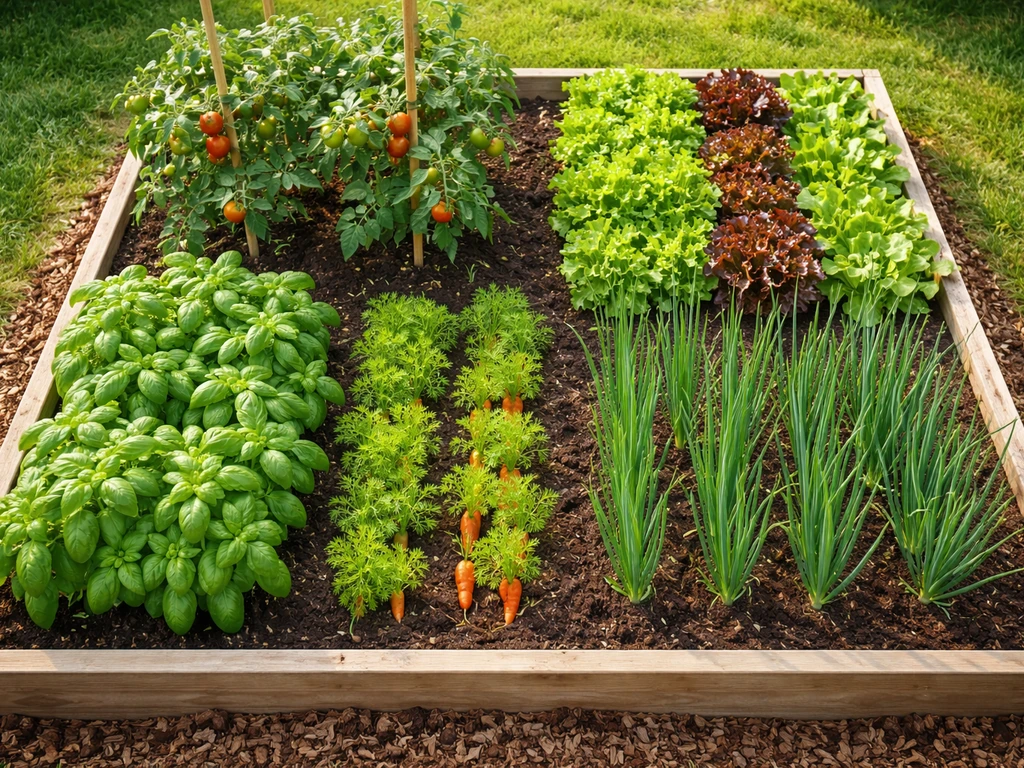
The best crops to grow together are ones that fill different niches in the same space: different root depths, different light needs, different nutrient demands, and complementary timing. If you’re pairing crops so you don’t run out of food before the next harvest, you can also use crop rotation and staggered timing to keep your bed producing. Tomatoes and basil, corn and pole beans, carrots and lettuce, peas and onions, and squash with almost anything tall enough to cast shade over it, these are the pairings that hold up in real gardens, not just on blank" rel="noopener noreferrer">charts. The core idea is that two plants growing side by side should help each other, or at least not hurt each other, and ideally do something the other can't do alone.
Best Crops to Grow Together: Pairings, Layout Tips, What to Avoid

How companion planting actually works (and what the word really means)
Companion planting gets thrown around loosely, so it's worth being precise: it means growing plants near each other so that one provides a specific, known benefit to the other. That benefit might be pest masking, attracting beneficial insects, fixing nitrogen, providing physical support, or filling harvest windows so you're not wasting bed space. It does not just mean "plants that happen to grow in the same bed." That distinction matters because a lot of companion planting claims online are not backed by solid research, and some of them contradict each other. The pairings worth trusting are the ones with a clear mechanism: why does this combination work, not just that it supposedly does.
The mechanisms that consistently hold up are: different root depths (so plants don't compete for the same water and nutrients), staggered timing (a fast-maturing crop finishes before a slow one needs the space), physical support (one plant provides a trellis or windbreak for the other), nitrogen fixation (legumes add nitrogen to the soil through root nodules, which benefits the whole bed over time), and biological pest management (certain herbs attract parasitic wasps or mask crop scent from insects). When you understand which mechanism you're relying on, you can adapt a pairing to your specific situation instead of following a chart blindly.
Best vegetable crop combinations and how to rotate them
These are the vegetable pairings I come back to every season because they work across a wide range of climates and bed sizes. Each one has a clear reason for working.
Tomatoes with basil and parsley
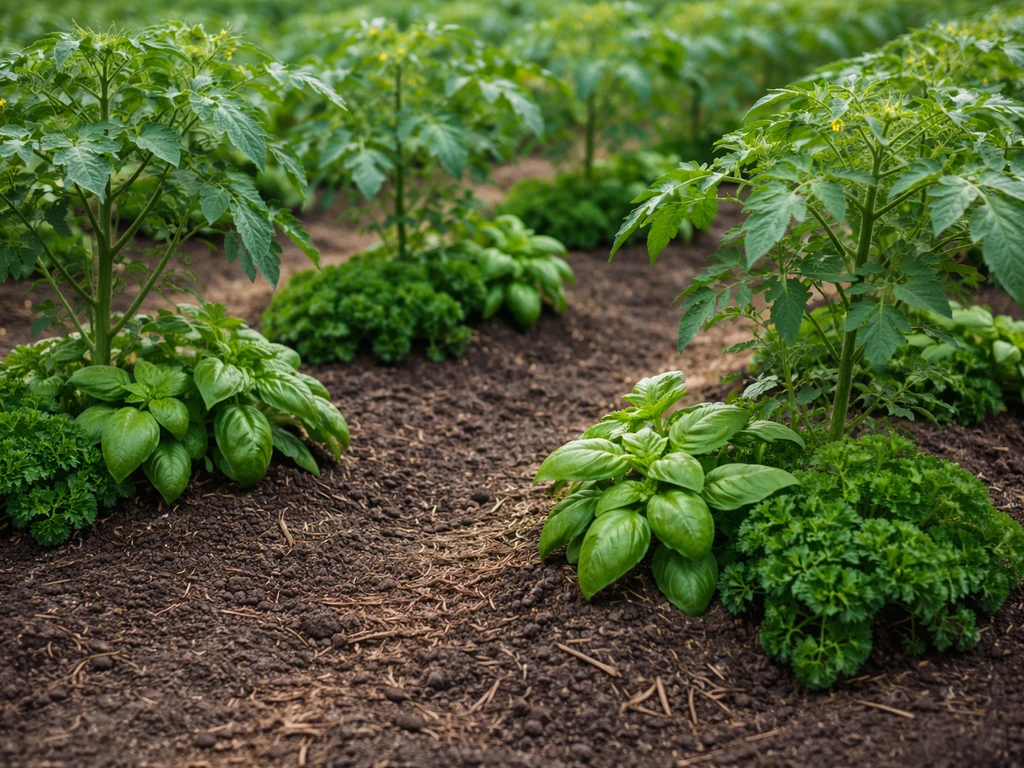
This is the most popular pairing for good reason. Basil interplanted with tomatoes can help mask the tomato plants from thrips and other insect pests that use scent to locate their host. Parsley fills a different role: it attracts beneficial predatory insects and uses very little space. Plant basil 12 to 18 inches from tomato stems, close enough to create a scent layer but far enough not to compete for light at the base. Let some basil go to flower later in the season, the blooms attract sweat bees and other beneficials.
Carrots with peas, lettuce, and onions
Carrots are slow-maturing and their feathery tops stay low, making them good neighbors for taller crops. English peas grow vertically, leaving carrot root space completely uncontested below ground. Lettuce fills in bare soil quickly and is done before carrots need full sun. Onions are shallow-rooted and their strong scent can confuse carrot fly, which makes them one of the most practical pairings in the allium-root vegetable category. Interplant these in alternating short rows or blocks of 6 to 9 inches per plant.
Onions with beets, cabbage family, and lettuce
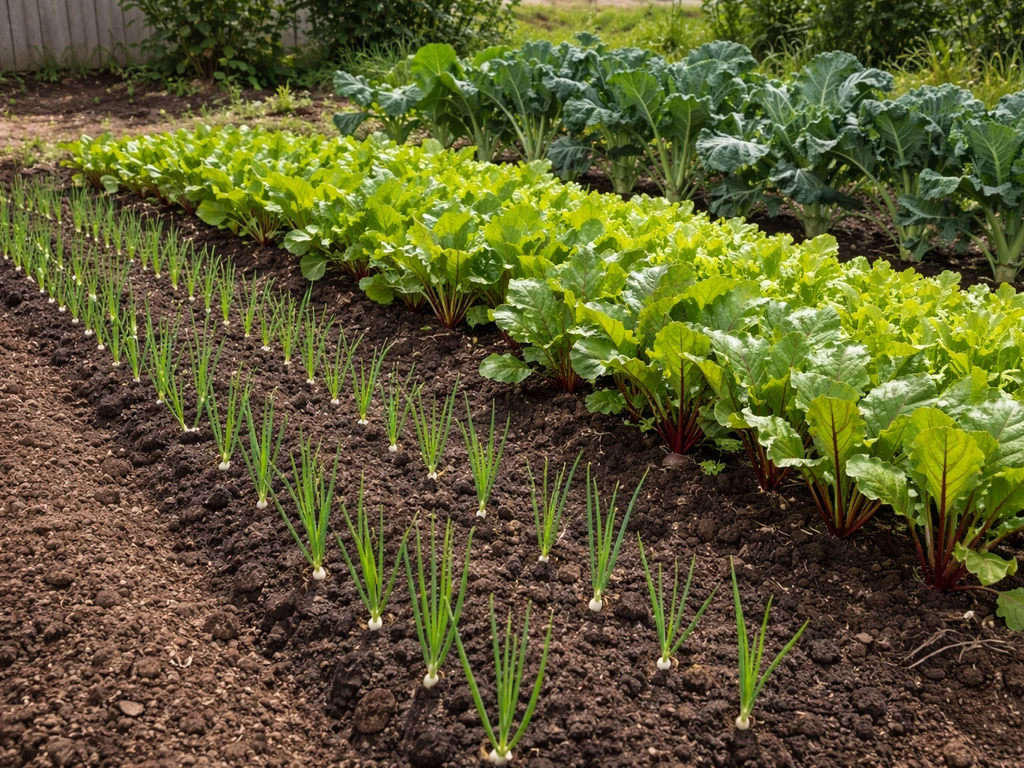
Onions work well beside beets and the whole cabbage family (cabbage, broccoli, kale, kohlrabi) because the root zones and canopy heights don't overlap much. Summer savory is an old companion for onions and beans: it's compact, aromatic, and reportedly improves the flavor of onions when planted nearby, though the flavor effect is anecdotal. The practical value is that it fills space without competing. Keep onions away from legumes, which we'll cover in the failure section below.
Spinach, beets, or lettuce between tomatoes and peppers
This is a timing-based pairing. Spinach, beets, and lettuce all want to finish before summer heat sets in. Tomatoes and peppers are transplanted in late spring and take weeks to get big. Plant your cool-season crops first, and by the time your tomatoes and peppers start spreading, the lettuce has been harvested and that space is freed up naturally. You get two harvests from one bed slot, and you never waste ground. I plant basil at the same time as my tomato transplants to fill in while the tomatoes are still young.
For rotation: move your tomato/pepper family to a different bed each year. Follow them with legumes (beans or peas) the next season to replenish nitrogen those heavy feeders pulled out. In year three, bring in brassicas (broccoli, cabbage, kale), which benefit from the nitrogen the legumes left behind. This three-year rotation reduces disease and pest buildup significantly.
Best herb combinations for pest control and pollinators
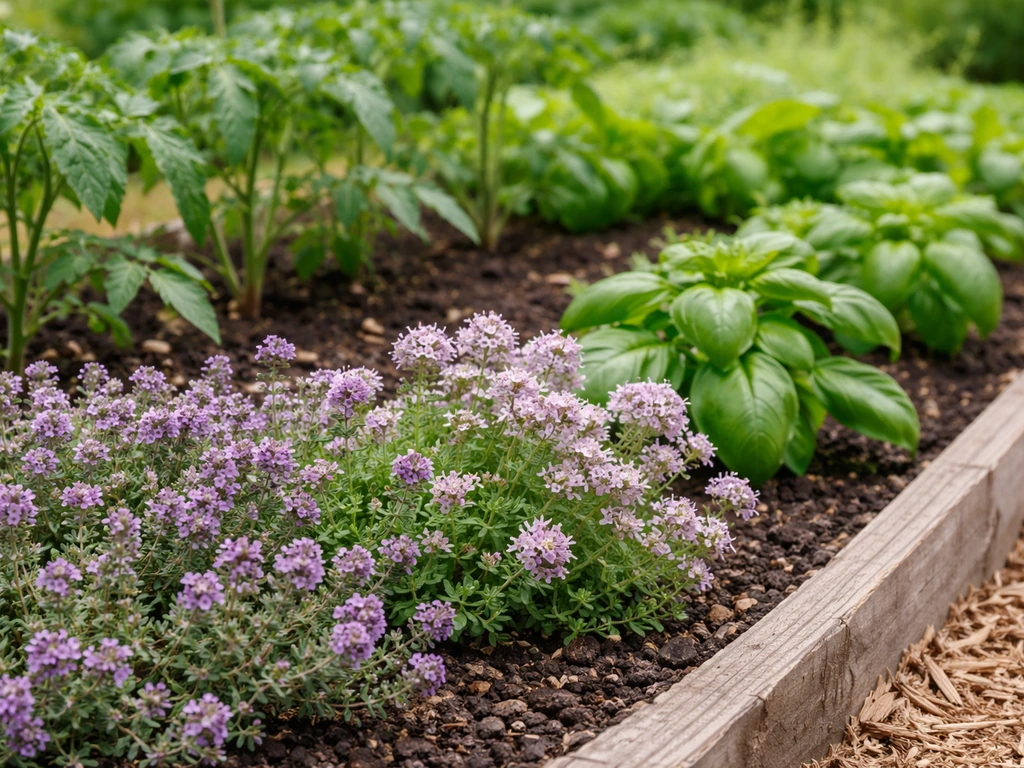
Herbs are some of the hardest-working plants in a companion system, but only if you use them correctly. The key is letting them flower. Rosemary, oregano, basil, and thyme all attract beneficial insects, specifically sweat bees and parasitic wasps, when their flowers open. Those wasps are predators of caterpillar pests like tomato hornworm, fruitworm, and diamondback moth caterpillars. Dill is particularly good at this: it pulls in parasitic wasps that target the exact caterpillars most likely to damage your tomatoes and brassicas.
Thyme used as a ground cover under tomatoes serves a structural purpose too. Dense thyme plantings form a low carpet that deters yellow-striped armyworm moths from laying eggs in the soil near the plant base. It also acts as a living mulch, reducing moisture loss. I plant creeping thyme around my tomato cages and let it spread, it stays under 4 inches tall and doesn't compete for light at all.
| Herb | Best grown with | Key benefit |
|---|---|---|
| Basil | Tomatoes, peppers | Masks crop scent from thrips; attracts beneficials when flowering |
| Thyme | Tomatoes, brassicas | Ground cover deters armyworm egg-laying; living mulch |
| Dill | Tomatoes, brassicas, carrots | Attracts parasitic wasps that target hornworms, fruitworms |
| Rosemary | Beans, brassicas | Attracts sweat bees and beneficial insects when blooming |
| Oregano | Squash, tomatoes | Attracts pollinators; low-growing and non-competitive |
| Parsley | Tomatoes, asparagus | Attracts beneficial insects; fills space without competing |
| Summer savory | Onions, beans | Aromatic deterrent; compact and non-invasive |
One thing to be honest about: herbs don't repel everything from everything. The mechanism is specific. Basil helps mask tomatoes from particular pests. Dill draws specific predatory wasps. Planting a ring of herbs around your garden doesn't create a magical pest barrier. But planting the right herb near the right crop, and letting some of those herbs bolt and flower, gives you real and measurable support.
Legumes, grains, and heavy feeders: building soil while you grow
This is the most productive and least appreciated category for home gardeners. Legumes (beans, peas, lentils) fix atmospheric nitrogen in nodules on their roots. That nitrogen doesn't become available to neighboring crops while the legume is alive and actively using it, but when the roots decay after harvest, the nitrogen releases into the soil and benefits whatever grows next. This is the real mechanism behind the Three Sisters planting system, and it works because the timing is built into the biology.
The Three Sisters: corn, beans, and squash
This is the most proven multi-crop combination in North American gardening. If you plan a Three Sisters planting, start by picking the crops you want to grow, then set up the spacing and timing so corn, beans, and squash work together who grow crops. Corn grows tall first and becomes the support pole for pole beans, which saves you the cost and space of separate trellises.
Beans fix nitrogen and reduce competition between corn and squash because their roots go to different depths than corn roots. Beans have nitrogen-fixing nodules, but the nitrogen is mainly available to the beans themselves, with benefits to corn and squash coming more from system outcomes than from shared nitrogen in the air Beans fix nitrogen.
Squash spreads wide along the ground, shading out weeds and helping retain soil moisture, effectively acting as a living mulch for the whole planting. The system is self-reinforcing: the squash shade helps the bean and corn seedlings in hot weather, and the beans replenish what the corn and squash pull from the soil.
For timing: plant corn first and give it a 2-week head start before adding pole beans at the base of each stalk. Squash or pumpkins go in at the same time as the beans or slightly after. If you plant all three at once, the squash can outcompete the young corn for ground space before the corn establishes dominance. I plant corn in hills of 4 to 6 stalks, add beans when corn is 6 inches tall, and put squash at the outside edge of each hill.
Peas before heavy feeders
If you're not doing a full Three Sisters planting, the simpler version is growing peas as a spring crop in a bed, then pulling them after harvest and immediately transplanting or direct-sowing a heavy feeder: corn, squash, tomatoes, or brassicas. The pea roots decay over the summer and release nitrogen right when your heavy feeders need it most. Cover crops like hairy vetch (a legume) do the same thing at a larger scale if you want to prep a whole bed before a heavy-feeding season crop.
Beans alongside potatoes and away from onions
Beans and potatoes are often listed as companions because they occupy different root zones (beans are shallower, potatoes go deeper), and beans add nitrogen while potatoes are moderate feeders. Avoid pairing beans with onions, garlic, or any allium, there's consistent real-world evidence that alliums inhibit bean growth, and this is one of the incompatibilities that does appear in research-backed companion charts.
How to lay out a bed so pairs actually work
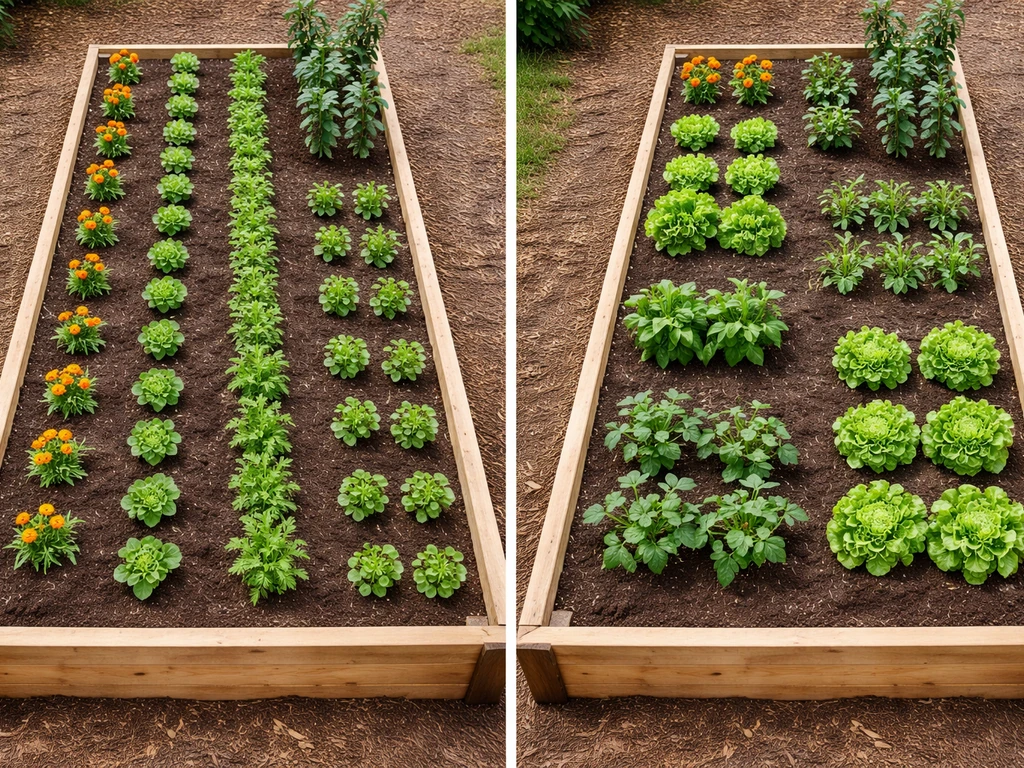
The most common mistake is treating companion planting as a reason to crowd plants together. Proximity helps, but plants still need their minimum spacing to perform. The goal is to fill niches, not fill every inch with competing root systems.
For a standard 4x8 raised bed, you have two main layout options: rows or blocks. Rows work better for crops you'll harvest repeatedly or need to access often (beans, brassicas, lettuce). Blocks or square-foot grids work better when you're interplanting companions of different heights and growth habits. In a block layout, you can place tall crops on the north side so they don't shade shorter companions, and low ground-cover plants on the south and sides.
For cucumbers or pole beans, running them along a trellis on the north or west edge of the bed is the most efficient use of space. Colorado State Extension recommends spacing cucumbers along a trellis at roughly 9x12 inches. Beans and peas are easier to harvest if grown in a single or double row down one side of the bed rather than scattered throughout. Lettuce, spinach, and radishes fill the foreground and open spaces between larger plants.
- Put tall crops (corn, staked tomatoes, trellised cucumbers) on the north side so they don't block sun from smaller companions.
- Plant fast-maturing crops (lettuce, radishes, spinach) in spaces that will be taken over by slow-growing neighbors (tomatoes, peppers, squash) within 6 to 8 weeks.
- Use ground-cover herbs (thyme, oregano) at the bed edges and under taller plants where nothing else will grow well.
- Leave at least the minimum recommended spacing for your heaviest feeder in the pairing — the companion fills in around it, not the other way around.
- Draw a simple map on paper before you plant. Mark where each crop goes and when it will be harvested or moved. This prevents the most common spacing mistakes.
For containers: stick to two-plant combinations rather than three. A 12-inch pot can support one tomato with basil underneath. A half-barrel works for a Three Sisters in miniature: one corn stalk, one bean, and a small-variety squash like 'Patio Star' or 'Bush Acorn.' Containers heat up faster and dry out quicker, so pair crops with similar watering needs, drought-tolerant herbs with drought-tolerant vegetables, moisture-loving crops with other moisture-lovers.
What goes wrong: pests, competition, and plants that fight each other
Allelopathy: when plants chemically block each other
Allelopathy is when one plant releases chemicals that inhibit the growth of another. The most extreme example is black walnut trees, which produce juglone from roots, leaves, and hulls, a compound toxic to tomatoes, peppers, eggplant, and many other crops. The toxicity zone extends well into the dripline and beyond, sometimes 50 to 80 feet from the trunk. If you're gardening near a black walnut, that's not a companion planting problem you can fix with spacing. Move the bed. At a smaller scale, fennel is the most notorious allelopathic garden plant: it inhibits most vegetable crops and should not be interplanted in a vegetable bed. Grow it in a container or well away from other crops.
Nutrient and water conflicts
Heavy feeders grown together without enough amended soil will compete intensely and both underperform. Don't plant corn next to squash without a legume in the system or without supplementing nitrogen, they're both hungry crops. Don't plant brassicas (broccoli, cabbage, kale) together with tomatoes if you're not actively fertilizing, because both pull heavily from the same nutrient pool. Match water needs too: drought-tolerant rosemary does not want to share a raised bed with moisture-hungry celery.
Shade suppression
Squash is great at shading out weeds, but it will also shade out any low companion you plant too close to its spreading canopy. Corn can shade bush beans if planted too densely. A good rule: any plant that produces large horizontal leaves (squash, pumpkin, zucchini) should only be paired with things that are either taller than it or that finish before it reaches full spread. Don't plant lettuce next to squash unless you're harvesting that lettuce before the squash vines take over.
Pest and disease concentration
Adding plant diversity to a bed doesn't automatically reduce pest pressure on any specific crop. A mix of plants can actually concentrate pests in one area if the pests have multiple hosts. Squash bugs will find your squash whether it's surrounded by beans or not. The more useful strategy is to not plant the same crop family in the same spot year after year (rotation), which breaks the pest life cycle.
If you have a recurring problem with a specific pest, rotating the host crop to a new bed location does more than companion planting alone. Track what happens in each bed from year to year, noting pest pressure, disease spots, and what performed well together, so you can make adjustments rather than repeating the same failures.
Timing incompatibility
Some plants simply can't coexist at the same growth stage even if they're technically compatible. Planting large-seeded corn in the same row as small-seeded carrots at the same time will result in corn shading out the slow-germinating carrots before they establish. The fix is sequencing: cool-season crops first, warm-season crops into the space they leave, then another cool-season crop or cover crop in fall. The rotation pattern of cool-season crops, then warm-season crops, then fall cool-season or winter cover crop is the backbone of an efficient small garden.
Incompatible pairs to avoid
- Fennel with almost anything: highly allelopathic, isolate it from the main vegetable garden
- Beans or peas with onions, garlic, or leeks: alliums consistently inhibit legume growth
- Brassicas with tomatoes in the same heavy-feeder rotation slot without nitrogen replenishment
- Squash with low companions that can't outpace its canopy spread
- Any crop near black walnut trees within the dripline zone
How to choose your pairings and build a simple planting plan
Start with your climate and your first and last frost dates. Cool-season crops (peas, lettuce, spinach, beets, carrots) go in 4 to 6 weeks before your last frost. If you want to go beyond companion planting and focus on staple food output, a good next step is learning how to grow crops once you have humans to feed, including basic succession planning and soil support Cool-season crops.
Warm-season crops (tomatoes, peppers, beans, corn, squash, basil) go in after your last frost date, once soil temps hit at least 60°F. Your companion pairings need to match this rhythm. If you are planning a place where farmers grow crops, use these same companion ideas to pair neighbors that share light and nutrient needs without competing. Pairing lettuce with tomatoes only works if you're planting the lettuce first and planning to harvest it before the tomatoes fill out.
If you're in a short-season climate (zones 3 to 5), you may not be able to do a full Three Sisters planting, stick to corn varieties with 75-day or shorter maturity, and use bush beans instead of pole beans to reduce risk.
For a small raised bed or container garden, pick two or three core pairings and do them well rather than trying to implement every combination at once. A reliable starter plan for a 4x8 bed: one section with tomatoes, basil, and thyme; one section with bush beans and carrots; one section with lettuce and radishes to be cleared for a late-season brassica planting. That covers pest management, soil building, timing efficiency, and a root-vegetable harvest all in one bed.
For larger in-ground plots, use the three-year rotation as your framework and slot companion pairs into each rotation block. Year one: tomatoes and peppers with basil and thyme. Year two: beans or peas with onions on the other side of the bed (keep legumes away from alliums in the same row, but they can share a rotation bed at separate ends). Year three: brassicas benefiting from the nitrogen the legumes left the previous year, with dill at the edges to attract beneficial wasps.
The best thing you can do beyond following any pairing guide is to keep notes. Write down what you planted together, when, what the pest pressure looked like, and what the harvest was. Companion planting is partly local, your pest pressure, your soil, your microclimate all affect what combinations perform. What works brilliantly in a humid zone 7 garden may underperform in a dry zone 9 bed with different insect populations. Give each combination two seasons before you judge it, adjust one variable at a time, and you'll build a pairing system that's genuinely tuned to your garden rather than borrowed wholesale from a chart.
FAQ
How do I choose the “best crops to grow together” if I have limited sun or shade?
Start by listing crops by light need, then treat tall crops as your “shade producers.” Place shade-tolerant plants on the north or east sides of beds and keep full-sun crops on the south or west. If you can’t avoid shade overlap, prioritize pairings that rely on different canopy heights (for example lettuce under taller brassicas that will be harvested later) rather than root-depth pairing alone.
What if I want to use companion planting for pests, but my problem is only on one crop?
Don’t assume a broad mixed planting will fix it. Identify the crop family the pest targets, then use companion plants that match the specific mechanism you need, such as herbs that flower to support parasitic wasps for caterpillars, or sacrificial plants that trap certain pests. Also check whether the pest is actually responding to humidity or watering patterns, since those can outweigh companion effects.
Can I plant the same companion pair every season to simplify planning?
You can repeat a pair, but you should still rotate the crop families in the same spot. Companion planting works best when the neighbors help with a niche each season, while rotation breaks pest and disease cycles over years. A practical rule is to repeat companion logic, not the exact crop in the exact bed indefinitely.
What’s the safest way to interplant without crowding and still get the benefits?
Use minimum spacing as the hard constraint first, then interplant only in leftover “niche” space. Good candidates are quick finishers (radish, lettuce) and low herbs that tolerate being near heavier feeders. If your garden needs to be thinned later, plan the thinning dates so you are not removing the very plants you planted for pest masking or timing.
How do I handle companion planting when seeds take very different times to germinate?
Sequence by starting the slow crop first or use a “starter row” approach. For example, start cool-season seeds that take longer under shade or with protection, then fill the space after emergence with faster crops. If you direct-sow everything on the same day, fast growers (like corn) can shade or outcompete slow germinators (like carrots) before they establish.
Do companion pairings work the same in containers and raised beds?
Not exactly, because containers intensify heat and drying and have less buffering. Stick to two plants per pot, match watering needs closely, and avoid pairings where one plant’s roots will dominate the limited volume. If one crop is a heavy feeder, either choose a lighter neighbor or plan extra feeding, since “compatible neighbors” can still starve each other in small media.
Is it okay to grow beans near onions if I’m doing rotation but not planting them simultaneously?
Avoid planting them together in the same growing period in the same space, because the incompatibility is strongest when they share active growth. If you are rotating, keep them in separate beds in different seasons and treat “rotation separation” as your fix, not just shifting spacing within the same bed during the same months.
What should I do if a companion pair worked once but fails the next year?
Treat it like a hypothesis that your conditions changed. Compare notes on pest pressure, soil moisture, and which crop variety you used, then change only one variable next season (watering schedule, planting date, fertilizer amount, or which member of the pairing you moved). After a failure, wait one full cycle before repeating the exact pair in the same micro-position.
How can I prevent allelopathy issues besides avoiding fennel and walnuts?
Watch for “mystery failure” where multiple unrelated crops underperform near a specific plant. Avoid planting vegetables directly under or near known juglone sources, and if you’re using plantings like fennel, keep them in a dedicated container. Also separate compost zones, since plant residues can sometimes persist and create localized inhibition.
What is a good starter plan if I’m new to companion planting and don’t want to micro-manage?
Pick two core goals and build only 2 to 3 pairings that support them: one timing pairing (cool-season crop harvested before warm-season spreads), one pest-support pairing (herbs that flower near the target crop), and one root-depth pairing (shallow with deep). Keep the rest of the bed simple, then add one new companion idea per season once you’ve tracked what worked.
Who Grow Grain for Us: Local Options and How to Start
Find who grows grain for us via local farms, co-ops, elevators, and start growing or sourcing at home.