
Yes, milk can genuinely help your garden grow, and if you're trying to scale up toward small commercial production, it's worth understanding exactly how. Diluted milk or whey works as a mild foliar spray, a soil drench, or a compost activator, delivering small amounts of nitrogen, phosphorus, potassium, and beneficial microorganisms to your plants. The sweet spot is a 10% solution (1 part milk to 9 parts water) applied as a foliar spray, or whey diluted 1:10 to 1:20 for soil or hydroponic feeding. Get the ratio or timing wrong, and you'll end up with a stinky mess that attracts pests instead of boosting yields.
Milk for Garden Growth: Safe Ways to Boost Yields

Marcus Hendrick
17 May 2026

What people actually mean by 'milk can help you grow commercial'
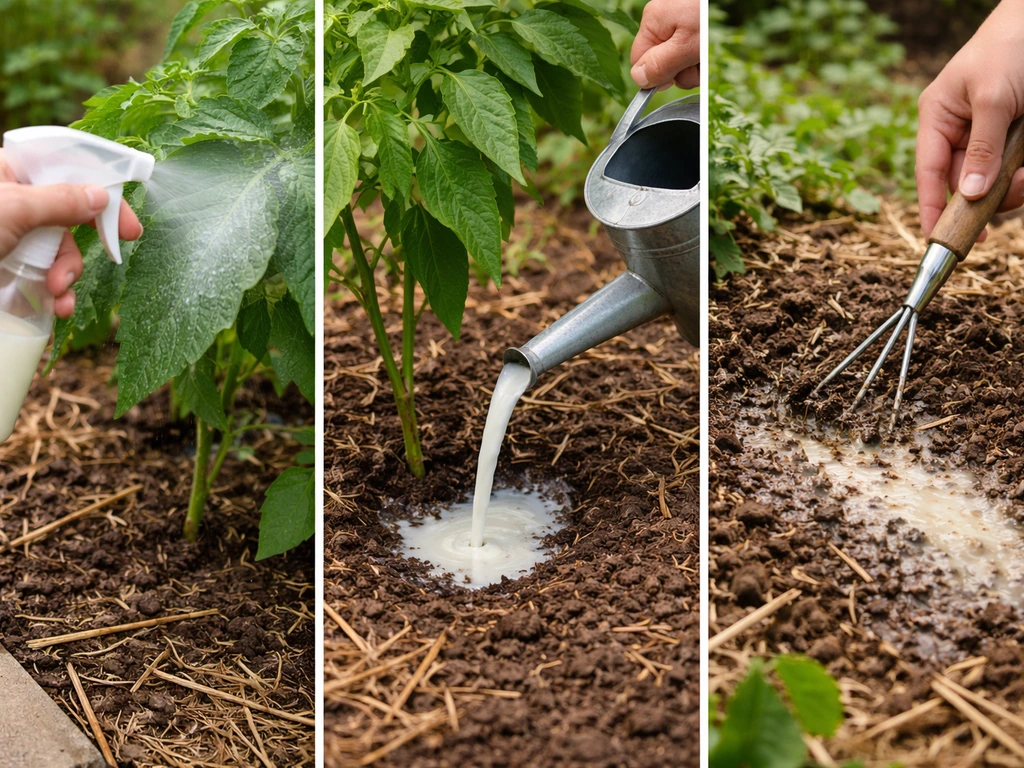
This phrase bundles together a few different ideas, so let's pull them apart. In a garden context, using milk to 'grow commercial' usually means one of three things: spraying diluted milk on plant leaves (foliar feeding or disease control), pouring diluted milk or whey onto your soil as a nutrient drench, or adding milk or whey to a compost pile to speed up microbial activity. The 'commercial' part points to scaling up, meaning you want yields good enough to sell at a farmers market, supply a small CSA, or at least reduce your input costs enough to make home growing financially worthwhile.
Milk-based inputs have been studied most seriously as a foliar treatment for powdery mildew control, where researchers traced the original work back to Bettiol's trials using fresh, unpasteurized, unhomogenized milk sprayed directly on plant leaves. Whey, the liquid left over from cheese or yogurt making, has also been evaluated as a legitimate nutrient solution containing measurable nitrogen, phosphorus, and potassium. So this isn't folk medicine. There's real science behind it, and that science gives us actual numbers to work with.
When milk helps plants and when it causes problems
Milk helps most when you have two specific problems: a powdery mildew pressure on cucurbits (squash, zucchini, cucumbers, melons) or a soil that needs a gentle microbial boost without the cost of commercial amendments. For powdery mildew, the milk spray works through a combination of microbial competition on the leaf surface, direct antifungal activity, and changes in the microenvironment on the leaf. Timing and the microorganism community in the milk both play a role, which is why fresh milk tends to outperform heavily processed versions.
For soil nutrition, whey supplies meaningful macronutrients and encourages microbial activity, which helps with nutrient cycling. But whey is acidic, and if your soil pH is already low (around 5.0 to 5.5), adding undiluted or lightly diluted whey can temporarily push acidity into the range where it injures plant roots. This is the most common way people run into trouble: they're trying to help and they end up burning plants or creating a waterlogged, sour-smelling soil patch.
Milk also causes problems when applied undiluted, applied in hot sun, applied too frequently, or left to pool on the soil surface. Undiluted milk on leaves causes salt burn and leaf scorch. Milk sitting on warm soil smells terrible within 24 hours and starts attracting flies, rodents, and neighborhood complaints. If you're growing food you plan to sell, that's a serious problem, not just a nuisance.
How to apply milk safely: dilution, timing, and method
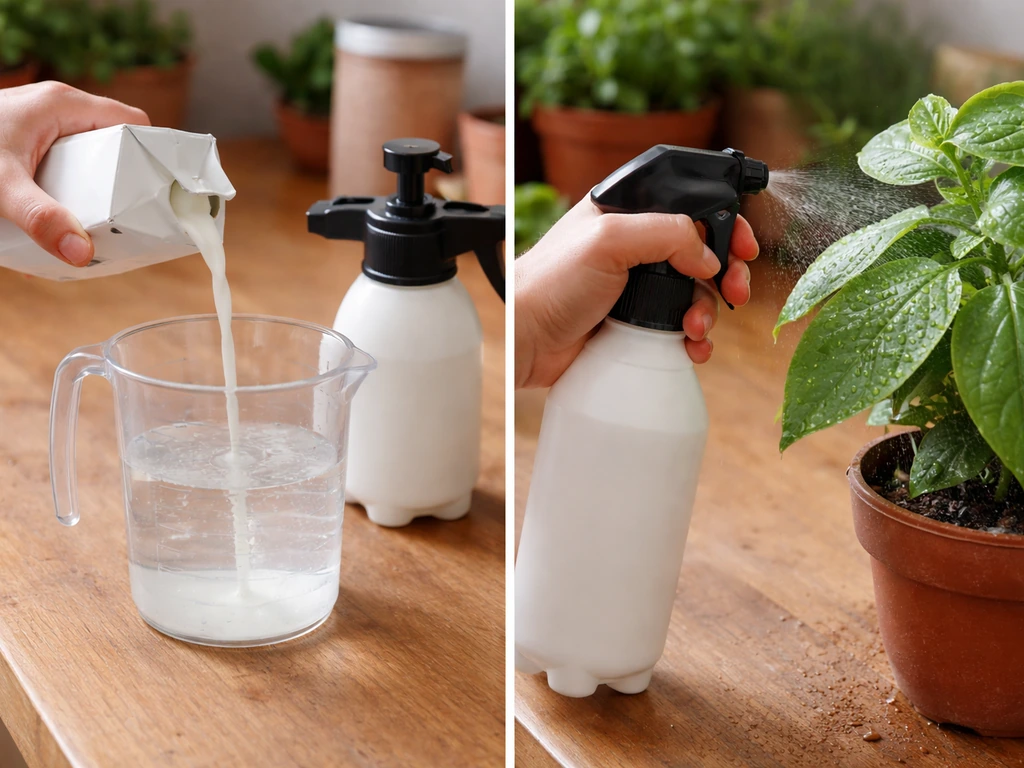
The most practical and well-tested application is the foliar spray. Mix 1 part milk to 9 parts water (a 10% solution) and load it into a clean spray bottle or pump sprayer. Apply it in the early morning so leaves have time to dry before the heat of the day. Wet leaves sitting in afternoon sun invite fungal problems, which defeats the purpose entirely. Spray until leaves are evenly coated but not dripping. Repeat twice a week when you're dealing with active powdery mildew pressure, or once a week as a preventive during humid stretches.
For a soil drench using whey, dilute to at least 1:10 (one part whey to ten parts water) and go to 1:20 if your soil is on the acidic side or if you're working with seedlings. Apply at the base of plants in the early morning, let it absorb fully, and don't repeat more than once every two weeks. Hydroponic research with lettuce, cabbage, and tomato found that neutralized whey at a 1:20 dilution produced vegetative growth comparable to commercial nutrient solutions, which tells you that lower concentrations can still do real work.
- Use a 1: 9 milk-to-water ratio for foliar spray (powdery mildew control or micronutrient boost)
- Use a 1: 10 to 1:20 whey-to-water ratio for soil drenches or hydroponic feeding
- Apply foliar spray in the early morning, never in full midday sun
- Let leaves dry completely before evening to prevent fungal issues
- Repeat foliar spray twice a week for active disease, once a week preventively
- Repeat soil drenches no more than once every two weeks
- Test soil pH before using whey if your soil runs acidic
Foliar spray vs. soil drench vs. compost: which approach fits your situation
Each method has a different job, and knowing which one fits your situation saves you a lot of wasted milk and wasted effort.
| Method | Best use | Pros | Cons |
|---|---|---|---|
| Foliar spray (milk) | Powdery mildew prevention and control on cucurbits and other susceptible crops | Fast acting, directly targets leaf surface pathogens, low volume needed | Smells if misapplied, must dry quickly, only works on leaf-level problems |
| Soil drench (whey) | Nutrient supplementation for leafy greens, tomatoes, and seedlings | Delivers N-P-K directly to root zone, encourages microbial activity | Can acidify soil, smells if overdone, requires pH monitoring |
| Compost addition (milk/whey) | Activating a slow or dry compost pile, adding microbial life | No direct plant contact risk, integrates nutrients into stable organic matter | Slow to benefit plants (weeks to months), can attract pests if pile is not hot enough |
My personal recommendation: start with the foliar spray if you're growing squash or cucumbers and tend to see powdery mildew every summer. It's the most studied application, the easiest to control, and gives you visible feedback within a week or two. Move to whey drenches if you're growing leafy greens at scale and looking for a low-cost nutrient supplement. Add milk or whey to compost only if you have a hot, active pile that can process it without attracting pests. A cold, slow pile with added milk is a recipe for a fly problem.
Which crops benefit most and what yields to realistically expect

Crops in the cucurbit family (zucchini, squash, pumpkins, cucumbers) are the most documented beneficiaries of milk foliar sprays, specifically because powdery mildew is one of the primary yield-limiting factors for these plants. Research on field pumpkins found that milk-based foliar sprays affected yield components in powdery-mildew-challenged crops. In practical terms, if powdery mildew normally knocks 20 to 30 percent off your squash harvest in late summer, consistent milk sprays from mid-season onward can protect a meaningful portion of that yield.
For leafy greens, the whey drench approach is most relevant. Lettuce, cabbage, and tomato all showed solid vegetative development in whey-fed hydroponic trials. In a soil garden, results will vary more because soil buffers and transforms inputs in ways a hydroponic system doesn't, but the basic principle holds: whey supplies nitrogen, phosphorus, and potassium, and plants respond to those nutrients whether the source is a bag of pelletized fertilizer or a bucket of diluted whey.
Fruiting crops like tomatoes and peppers can benefit from whey drenches during the vegetative stage, but be careful as plants move into flowering and fruiting. Excess nitrogen at that stage pushes leafy growth at the expense of fruit set. Treat whey drenches as a seedling and early-season tool for fruiting crops, not a season-long supplement.
- Zucchini, squash, cucumbers, pumpkins: high benefit from milk foliar spray for powdery mildew management
- Lettuce and cabbage: strong response to diluted whey as a nutrient drench or solution
- Tomatoes: useful during vegetative stage, reduce or stop drenches at flowering
- Peppers and eggplant: similar to tomatoes, best used early
- Seedlings (any crop): gentle 1:20 whey drench can boost establishment without burn risk
- Root vegetables and brassicas: limited evidence either way, use cautiously
Safety, smell, pests, and keeping it sanitary
This is where a lot of well-intentioned milk gardeners go wrong. Raw (unpasteurized) milk carries real pathogen risks. The FDA identifies Salmonella, E. coli, and Listeria as potential contaminants in raw milk, and that matters when you're applying it to food crops. If you're using raw milk as a foliar spray on leafy greens you plan to eat or sell fresh, you need to observe a meaningful interval between the last application and harvest, and you need to wash produce thoroughly. For crops where the edible portion is a fruit or root that doesn't contact the spray directly (squash, tomatoes, winter squash), the risk is lower but still worth managing.
For soil drenches, treat raw milk and whey the way you'd treat any animal-origin soil amendment. FDA guidance on biological soil amendments of animal origin points to application timing relative to harvest as the key risk factor. The longer the interval between application and harvest, the lower the pathogen risk. A good rule of thumb is at least 90 days before harvest for soil-contact crops (root vegetables, lettuces growing close to the ground) and a minimum 120-day interval for anything being sold commercially. Composting milk inputs first, in a hot pile that reaches proper temperatures, is the safest approach if you're supplying a farmers market.
On pests and smell: any milk applied at higher concentrations than recommended, or left to pool, will sour within a day in warm weather. This attracts flies almost immediately and can attract larger animals (raccoons, dogs, rodents) depending on your location. Keep applications light and well absorbed. If you're spraying foliar, wipe up any puddles or drips. For soil drenches, apply before the hottest part of the day and in volumes the soil can absorb within an hour or two. If you smell milk in your garden 24 hours after application, you applied too much or too concentrated.
Scaling up: cost-benefit math for moving from home garden to small commercial
If you're thinking about selling produce at a market level, milk-based inputs can make sense financially, but only under specific conditions. The biggest cost factor is the milk or whey itself. At retail prices, milk is too expensive to compete with even organic liquid fertilizers on a per-nutrient basis. Where milk inputs genuinely win on cost is when you're sourcing whey as a byproduct, meaning you're already making cheese or yogurt at home, or you have a relationship with a local dairy or cheesemaker who would otherwise dispose of it. In that case, your input cost approaches zero, and the N-P-K in whey becomes effectively free.
Here's a simple way to think about the math. A 1:10 whey drench applied once every two weeks to a 100-square-foot bed of lettuce uses roughly 1 to 1.5 gallons of whey per application. If you're getting whey free or near-free from a local source, your nutrient cost for the season on that bed is essentially zero. Compare that to a quality liquid organic fertilizer at $15 to $25 per gallon, used at label rates every two weeks, and the savings add up fast across a market garden with multiple beds.
For powdery mildew management with milk spray, compare the cost against sulfur-based or copper-based organic fungicides, which run $10 to $30 per treatment depending on your acreage. A milk spray using retail milk at 10% concentration costs roughly $0.10 to $0.15 per quart of spray solution. At that price, even using store-bought pasteurized milk, milk spray is competitive with commercial organic fungicides for small-scale cucurbit production. The research on lettuce, cabbage, and tomato used defined dilution ratios (1:5, 1:10, 1:20) as working nutrient concentrations, which you can directly translate into a feeding schedule and per-gallon input cost to benchmark against whatever you're currently spending.
To set realistic yield targets: don't expect milk inputs alone to transform mediocre soil or overcome major pest and disease pressure. Think of milk and whey as one part of a complete fertility and disease management program, not a standalone solution. If you're considering whether milk is a grow food, it helps to place it within the bigger fertility and disease-management plan milk and dairy inputs.
The best commercial-scale results come from combining milk foliar sprays for disease prevention with whey drenches for early-season fertility, alongside solid soil preparation, crop rotation, and appropriate spacing. If you're exploring how milk and dairy inputs fit into a broader self-sufficiency model, it's worth looking at the full picture of what dairy animals contribute to a homestead food system, including how organic milk production connects to soil and plant health in ways that go beyond just the liquid itself. If you are comparing water use for almonds versus beef, the same kind of cost-efficiency thinking can help you weigh how your garden inputs and yields stack up.
If you're aiming for results like this, choosing good to grow organic milk and pairing it with soil-prep and rotation can help support healthier plants. Because water use differs a lot between almonds and beef, the footprint can look very different even when both are about "food production. " water use between almonds and beef.
Start small and measure. Run one bed with milk or whey inputs alongside one bed without, keep notes on plant size, disease pressure, and final harvest weight, and calculate your actual cost per pound of produce. That's the only way to know if it's working in your specific soil, climate, and crop mix. The research gives you the ratios and the principles. Your garden gives you the real answer.
FAQ
Can I use pasteurized milk instead of fresh raw milk for foliar spraying?
Yes, but pasteurization changes what works best. Pasteurized milk is generally safer for reducing pathogen risk, but fresh (non-homogenized, unpasteurized) milk tends to outperform for powdery mildew when you use it as a foliar spray. If you switch to pasteurized milk, stick closely to the 10% dilution and the early-morning timing, and expect you may need to keep a consistent spray schedule during high mildew weeks.
Will milk replace all my fertilizer needs if I’m trying to grow commercial quantities?
Don’t use milk as a full replacement for a fertilizer program. Milk and whey are mostly a mild nutrient plus microbial input, and their nitrogen level is not enough to substitute for a balanced fertility plan in most commercial settings. Use them to fill a specific role (mildew prevention on cucurbits, early-season fertility on leafy greens), then keep your soil fertility and micronutrients covered through your normal amendment strategy.
Is it safe to spray milk on leafy greens I plan to sell at a farmers market?
Yes, but only if you control risk and contact. If your edible portion is leaves (lettuce, many greens), spray can increase food-safety concerns, so plan a meaningful interval to harvest and wash thoroughly. If you’re growing squash or tomatoes where the edible part usually is not directly hit, the direct contact risk is lower, but you still want to avoid puddling and re-spray only as needed.
How should I decide the last day to apply milk or whey before harvest?
Start counting from the last application, and be conservative when plants are heavily sprayed. The article notes that raw milk needs a meaningful interval before harvest, with longer lead times for soil-contact crops and commercial selling. Practically, if you are aiming for a sale window, build in at least several weeks of buffer and keep a log of application dates per bed.
What if my soil pH is already low, can I still use whey?
It depends on the milk product and soil pH. Whey is more likely to lower pH, so if you’re already near 5.0 to 5.5, use the lighter end of the dilution range (like 1:20) and start with a single application to test plant response. Avoid undiluted whey and avoid repeating too frequently on acidic beds.
How long can I keep diluted milk or whey before applying it?
Mix only what you’ll use, and don’t store diluted milk/whey for long periods. If it sits warm and starts souring, you lose consistency and increase pest and odor risk. If you must pre-mix for logistics, store cold, label the batch with the mix time, and discard anything that smells strongly “off” before application.
What’s the best way to prevent milk from attracting flies or rodents?
Yes, but apply it in a way that won’t create standing liquid. For foliar spray, coat leaves evenly and stop before it drips. For drenches, apply volumes your soil can absorb within about an hour or two, and avoid letting it pool in low spots, because pooling is where the stinky, pest-attracting problem starts.
If milk helps powdery mildew, can I stop my other disease control practices?
Usually no, if you’re talking about replacing a regular fungicide schedule for active disease. Milk can help with powdery mildew, but it’s not a broad, guaranteed cure, and timing matters. During high pressure, the article recommends consistent foliar applications (twice weekly during active mildew), and milk should be combined with spacing, ventilation, resistant varieties, and sanitation.
Does homogenized or ultrapasteurized milk work the same for powdery mildew?
Fresh milk is often the most effective for powdery mildew because the microbial and surface activity likely differ from heavily processed milk. If your goal is mildew control, choose minimally processed milk when possible, and avoid turning it into a highly diluted “spray-and-forget” product. Still, the biggest lever is correct timing and frequency.
Can whey drenches be used on tomatoes, and how do I avoid hurting fruit set?
Yes, but manage nitrogen timing. The article warns that too much nitrogen during flowering and fruiting can reduce fruit set, pushing leafy growth instead. For fruiting crops like tomatoes and peppers, treat whey drenches as an early-stage tool (seedling to early vegetative), then dial back once flowering starts.
How do I measure whether milk actually improves profits for my farm or CSA?
Use it as an experiment with measurements, not a tradition. The article suggests running matched beds with and without milk inputs, recording disease pressure and yield weight. To make the results “commercially useful,” also track total input cost per pound and the time spent applying, because labor can erase the savings if the spray schedule is too frequent.
Is it better to add milk to compost rather than spray or drench?
Yes, but be careful with pile conditions. Adding milk or whey to compost only makes sense in an active hot pile that reaches proper temperatures. A cold, slow pile can attract flies and create odor problems, so if your compost is not reliably hot, stick to foliar spray or whey drench instead.
Next Article
Cheese Is Grow Food? How to Produce Cheese Inputs at Home
Cheese isnt a crop. Learn how to make cheese at home and what to grow or raise for milk and animal feed.