To grow enough wheat to supply a family of 4 for a full year, you're looking at roughly 500–540 lb of clean grain, which means planting somewhere between half an acre and a full acre depending on your soil and local conditions. That's the short answer. The longer answer is that the math involves several moving parts: how much flour your family actually eats, what yield you can realistically expect from a home plot, and how much grain disappears between harvest and your flour bin. This guide walks through every step so you can plug in your own numbers and get a real estimate for your situation.
How Much Wheat to Grow for a Family of 4: Plan Your Acres

Marcus Hendrick
17 Apr 2026
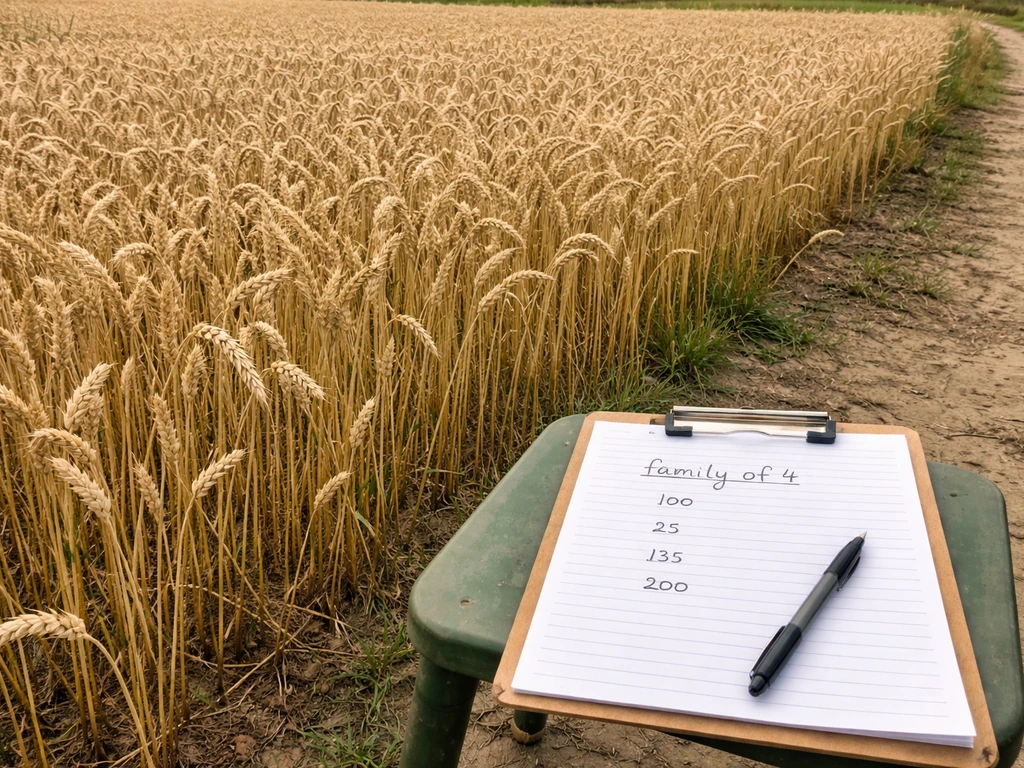
What does 'wheat for a family of 4' actually mean?
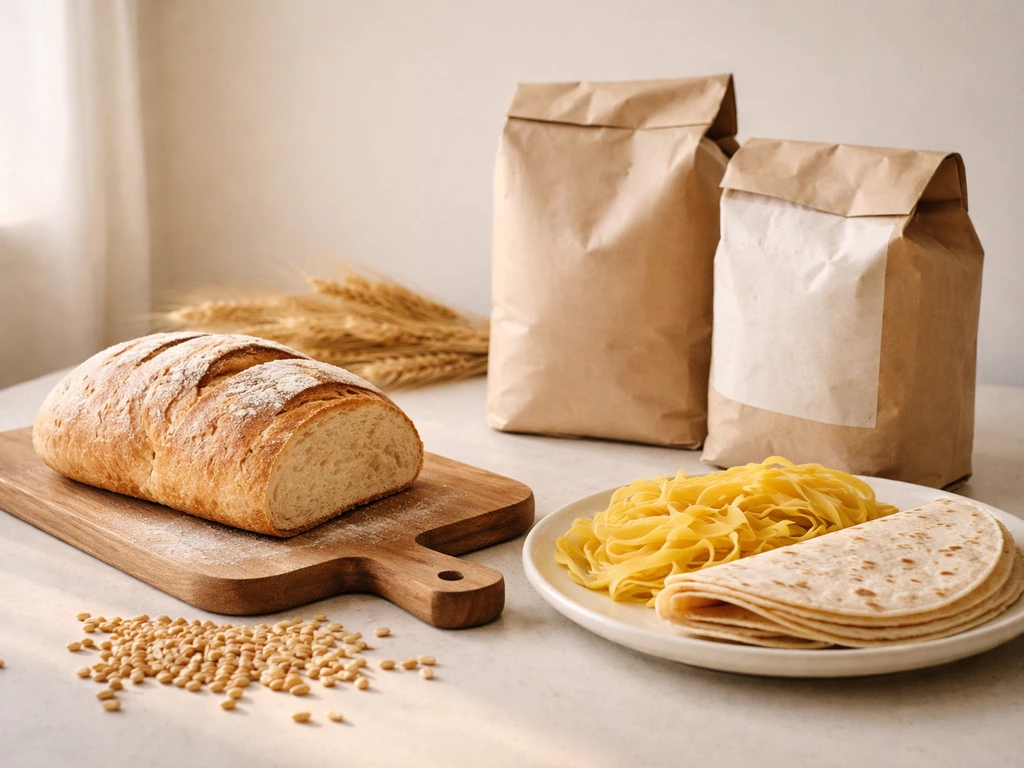
Before you can calculate area, you need to nail down what you're trying to produce. 'Wheat' in a family context usually means flour for baking bread, pasta, tortillas, and general cooking. It doesn't typically include wheat berries for porridge or animal feed, though some families want both. For planning purposes, stick with flour as the primary goal because it sets a clean consumption target.
One important assumption: are you trying to replace all the flour your family buys, or just a meaningful portion of it? Replacing 100% is the hardest scenario and a single crop failure would leave you short. Many homesteaders aim for 50–75% self-sufficiency and supplement from the store in lean years. That said, this guide sizes everything for 100% replacement so you can scale back as needed.
Also decide early whether you want whole wheat flour or white flour. Whole wheat milling has an extraction rate of essentially 100% (all of the grain becomes flour), while white flour uses only about 67–78% of the grain by weight. If your family bakes mostly with white flour, you'll need more grain to hit the same usable flour target. For this guide, I'll use whole wheat as the baseline and flag adjustments for white flour where relevant.
How much flour does a family of 4 need per year?
USDA data puts U.S. per-capita flour consumption at roughly 132–135 lb per person per year. That's a population average that includes people who barely bake and people who bake every day, so treat it as a reasonable baseline rather than a precise rule. A family that bakes all their own bread and makes pasta at home will probably be above that number; a family that only occasionally bakes may be below it.
If you want to get more precise, how much wheat to grow per person breaks down the individual calculation in detail, but for a family of 4 the working number is about 132–135 lb per person times 4, which lands at roughly 528–540 lb of flour per year. I'll use 540 lb as the planning target since rounding up is always safer when you're dealing with crop variability.
| Flour Type | Grain Needed for 540 lb Flour | Extraction Rate |
|---|---|---|
| Whole wheat flour | ~540 lb grain | ~100% |
| White flour (home mill) | ~700–810 lb grain | ~67–77% |
| Blended (50/50) | ~600–675 lb grain | ~85% blended estimate |
If your family uses mostly white flour, budget closer to 700–810 lb of clean grain to cover the milling losses. That significantly changes the area you need to plant, so be honest about what you'll actually bake with before finalizing your numbers.
Realistic yield: what can you actually grow at home?
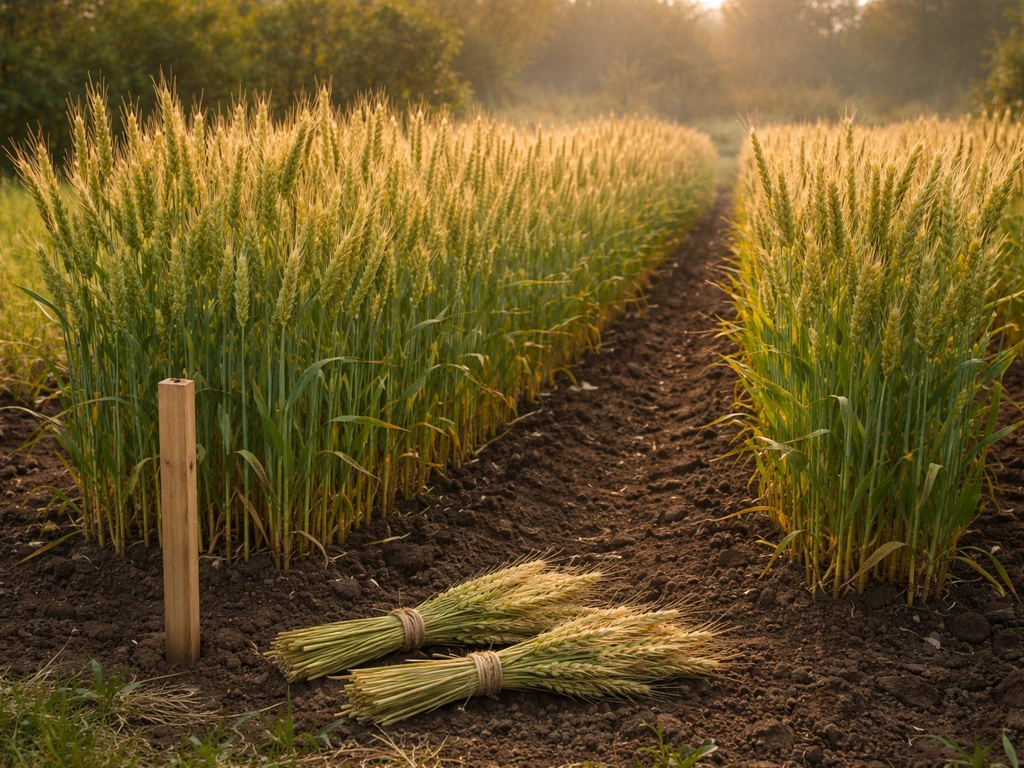
This is where a lot of people get tripped up by optimistic numbers. Commercial U.S. winter wheat averages around 53–54 bushels per acre at the national level, according to USDA NASS data. One bushel of wheat weighs 60 lb, so that commercial average works out to roughly 3,200 lb per acre. Home gardeners and small-plot growers without precision equipment, optimized varieties, or professional weed control rarely hit that. A more realistic planning range for home plots is 20–40 bushels per acre (1,200–2,400 lb/acre), with 25–30 bushels per acre (1,500–1,800 lb/acre) being a reasonable middle estimate for a first or second-year grower.
Your actual yield will depend heavily on soil fertility, weed pressure, disease, rainfall, and timing. Understanding what wheat needs to grow well will help you push toward the higher end of that range. Poor soil or heavy weed competition can easily cut yields in half, so don't plan on best-case numbers until you've grown a test plot and seen what your land produces.
Converting your grain target to harvest pounds
You don't get to eat every pound the crop produces. Between harvesting, threshing, drying, cleaning, and storage, expect to lose roughly 5–15% of field weight before you have grain ready to mill. FAO post-harvest research puts field-to-storage losses from harvesting (about 0.35%), threshing (about 1.24%), and farm storage (about 3.3%) when you add them up, plus drying and handling bumps that number further. Planning for a 10–15% combined loss is realistic for a small-scale setup without commercial drying equipment.
So if your target is 540 lb of clean, milled whole wheat flour, you need about 540 lb of clean dry grain ready to mill. Working backward through a 12% processing loss, you need your harvest to yield roughly 615 lb of raw grain from the field. Use that 615 lb figure as your minimum harvest target.
How much land does that translate to?
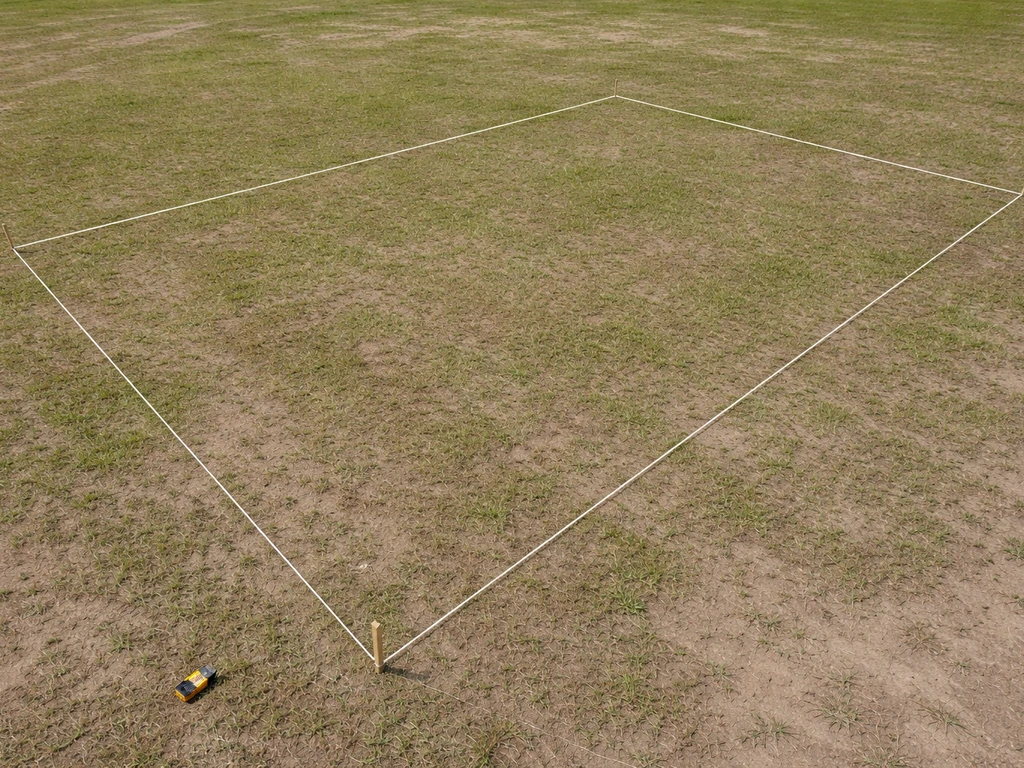
With a planning yield of 1,500 lb per acre (about 25 bushels/acre) and a harvest target of 615 lb, you need roughly 0.4 acres, or about 17,500 square feet. At the more optimistic 2,000 lb/acre, you could get away with about 0.3 acres (13,000 sq ft). At the conservative 1,200 lb/acre end, plan for closer to 0.5 acres (about 22,000 sq ft). The table below maps this out clearly.
| Yield Assumption | Area Needed (acres) | Area Needed (sq ft) | Risk Level |
|---|---|---|---|
| Conservative: 1,200 lb/acre (20 bu/acre) | 0.51 acres | ~22,200 sq ft | Safe buffer for poor years |
| Moderate: 1,500 lb/acre (25 bu/acre) | 0.41 acres | ~17,900 sq ft | Reasonable first-year target |
| Optimistic: 2,000 lb/acre (33 bu/acre) | 0.31 acres | ~13,500 sq ft | Requires good soil and management |
| Commercial avg: 3,200 lb/acre (53 bu/acre) | 0.19 acres | ~8,300 sq ft | Unrealistic for most home plots |
My honest recommendation: plan for 0.5 acres your first year. That gives you a buffer against low yields, disease, or a bad weed year, and it's still a manageable plot for one or two people to manage without large equipment. If your yield comes in strong, you'll have extra grain for seed stock or animal feed. If it comes in light, you won't be completely short on flour.
Planning your planting: seed rate, variety, timing, and soil
How much seed do you need?
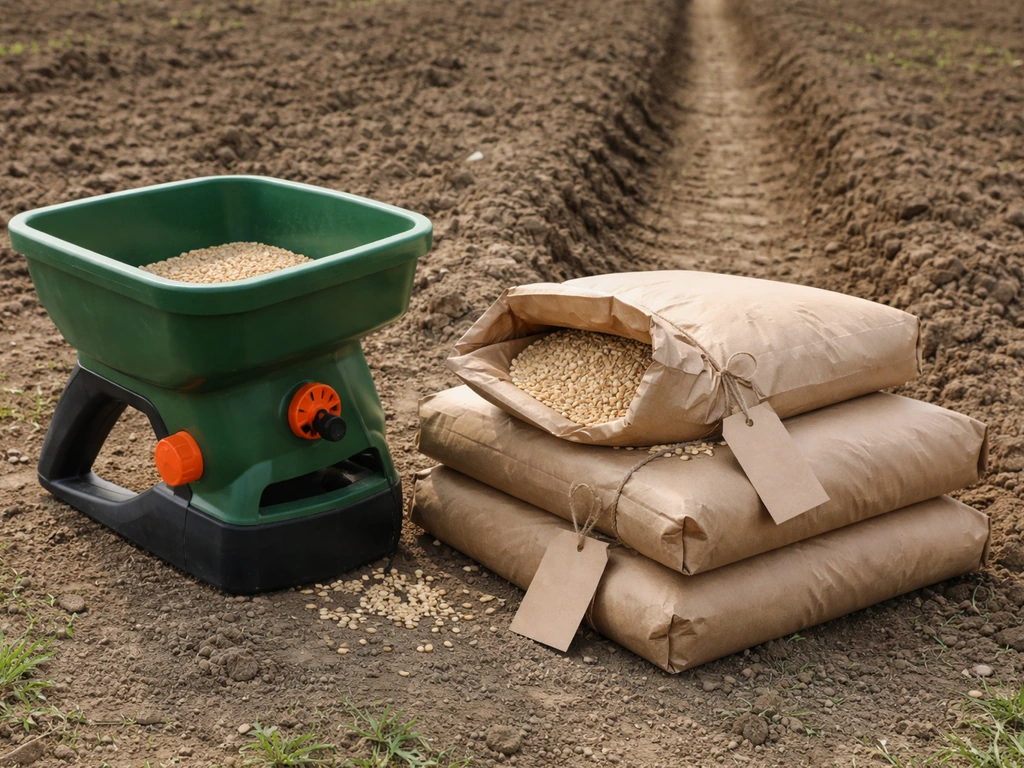
Seeding rate recommendations vary based on method and seed size. For drilled wheat (placed in rows with a grain drill or push seeder), a common rate is around 75–120 lb of seed per acre. For broadcast seeding (spreading seed by hand or spreader and raking it in), you need more: closer to 120–150 lb per acre to compensate for uneven placement and lower germination rates. Penn State Extension puts stand establishment targets at 400,000 to 1.5 million seeds per acre depending on conditions, and NC State Extension recommends 1.6–2.1 million seeds per acre for soft red winter wheat, which underlines why broadcasting requires more seed to hit adequate plant density.
For 0.5 acres with broadcast seeding, budget 60–75 lb of seed. With a drill or row seeder, 40–60 lb should be enough. One note: seed size varies a lot by variety, so if you can get the seeds-per-pound count from your supplier, use that to calculate more precisely rather than going purely by weight. Penn State Extension also explains how to convert seed tag “seeds per pound” into the required seed pounds per acre for home-plot seeding calculations One note: seed size varies a lot by variety, so if you can get the seeds-per-pound count from your supplier, use that to calculate more precisely rather than going purely by weight..
Which variety should you plant?
Variety choice matters a lot, both for yield and for what you end up baking. Hard red winter wheat has high protein (around 12% in a typical year) and makes excellent bread flour. Soft white winter wheat has lower protein and is better for pastry and all-purpose baking. For a family focused on bread, hard red is the stronger choice. To dig into this decision, the best wheat to grow for bread covers variety selection in much more detail, including which varieties perform well in different growing regions.
Also double-check that your chosen variety is adapted to your region. Winter wheat (planted in fall, harvested in summer) works well across most of the U.S., but spring wheat is the better choice for areas with very harsh winters or short fall seasons. Winter wheat needs vernalization, a period of cold exposure (roughly 30–75 days near 30–60°F) to trigger proper head formation. If you plant too late in fall, the plant may not get enough cold time and will produce fewer heads or mature poorly, directly cutting your yield.
Timing and soil basics
For winter wheat in the northern half of the U.S., planting windows generally run from early September through mid-October depending on latitude. As a reference, UMN Extension recommends planting between September 1–15 north of I-94 in Minnesota, September 10–30 in the central band, and September 20 through October 10 for the southernmost areas. In warmer southern states, October and even early November plantings are common. Planting too early invites disease pressure; too late and the plant won't harden before hard freezes. Alabama Cooperative Extension research confirms that both planting date and variety choice directly affect head formation and test weight, so this timing decision isn't trivial.
On soil: wheat is not particularly fussy but rewards decent preparation. A well-drained loam or clay-loam with a pH of 6.0–7.0 is ideal. Till or spade the plot, remove large debris, and ideally get a soil test so you know if you need to add nitrogen or lime before planting. Weed control at planting time pays enormous dividends: dense weed competition can reduce wheat yields by anywhere from under 1% to nearly 50% depending on the weed species, according to WSSA research. Cultivating thoroughly before drilling seed and keeping the plot as clean as possible early in the season is one of the highest-return investments you can make.
From harvest to flour: the math you need to know
Wheat is ready to harvest when the grain is hard and the straw has turned golden, typically late June or July for winter wheat. For small plots, hand harvesting with a scythe or sickle is practical, followed by bundling and drying in shocks for a week or two before threshing.
Threshing and cleaning
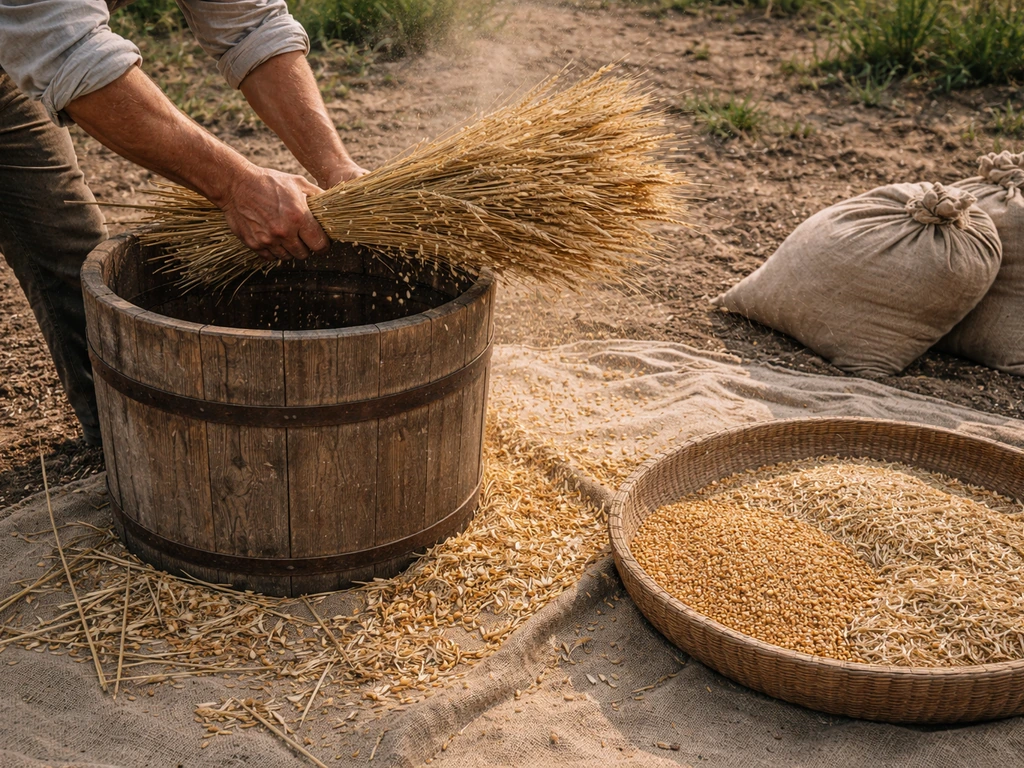
Threshing is separating grain from the stalks. On a small plot, this can be done by beating bundles against the inside of a barrel, walking on the sheaves on a tarp, or using a small electric thresher. After threshing, you'll have grain mixed with chaff and broken straw. Winnowing (pouring the mix in front of a fan or on a breezy day) blows the light chaff away and leaves the heavier grain. This takes longer than most people expect, so build time into your plan.
Clean grain needs to dry down to 13–14% moisture before storage. If you harvest in humid conditions or during rain, artificial drying is necessary: spreading grain thinly in a warm, ventilated space or using a small grain dryer. NDSU recommends a maximum storage moisture of 14% for storage up to 9 months, and 13% or below for longer-term storage. Storing grain at too high a moisture invites mold and insect damage, which can wipe out months of work quickly. A cheap grain moisture meter (around $20–40) is a worthwhile purchase.
Loss budget from field to flour bin
- Harvest losses (missed heads, shattering): ~1–2%
- Threshing losses (grain left in straw): ~1–2%
- Cleaning and winnowing losses: ~1–2%
- Drying weight loss (moisture reduction): ~2–3%
- Storage losses (insects, moisture, rodents) over 6–12 months: ~2–5%
- Total expected loss: roughly 7–14% of field weight
Using a 12% combined loss estimate, a 615 lb field harvest shrinks to about 541 lb of clean, dry grain ready for your mill, which is close to our target. If you mill whole wheat, that 541 lb is essentially your flour yield. Thinking about how bread grows from seed to loaf can help you appreciate just how many transformation steps happen before wheat reaches your table, and where to focus your energy to reduce losses at each stage.
Risk factors that can throw off your estimate
Wheat is a relatively resilient crop, but growing it at home without professional inputs means you need to plan for things going sideways. Here are the main risk factors and rough impact estimates:
- Stripe rust (fungal disease): USDA ARS research shows yield losses up to 40% in heavily affected fields. Plant disease-resistant varieties and scout regularly.
- Leaf rust: Kansas State Extension data links moderate to severe rust outbreaks to meaningful yield losses; severity determines impact. Fungicide application or resistant varieties are your main levers.
- Weed pressure: can reduce yield from under 1% to nearly 48% depending on species. Clean seedbed prep and early weed control are essential.
- Drought or excess moisture at heading: timing-sensitive; little you can do except choose a drought-adapted variety for your region.
- Vernalization failure from late planting: poor head formation, dramatically reduced grain fill. Plant on schedule.
One thing worth knowing early: not all wheat seed available cheaply is suitable for food production. Feed-grade wheat is sometimes treated or mixed with lower-quality lots, and it's worth understanding whether feed wheat will actually grow and produce a crop before you commit to planting it. Using certified seed or untreated grain from a known source is the safer path.
Start small, measure, then scale up
If you've never grown wheat before, don't plant half an acre in year one. Start with a test plot of 1,000–2,000 square feet. That's roughly a 40x50 foot patch, which is very manageable to plant by hand, weed, and harvest without any special equipment. At a moderate yield of 1,500 lb/acre, a 2,000 sq ft plot should produce about 70 lb of grain after processing, which is enough to bake with regularly and get a real feel for the workflow.
After your test plot season, calculate your actual yield per square foot, note your loss percentages at each step, and then scale up the math to figure out what area you'd need for the full family supply. Your real numbers will almost always differ from the averages, and plugging your actual yield into the formula will give you a much more accurate acreage target than any general guide can provide.
The cost-benefit reality
Let's be honest about the economics. Wheat flour costs roughly $0.50–1.00 per pound at the store, so 540 lb would cost $270–540 per year. Growing your own requires seed ($20–40 for half an acre), soil amendments, and a significant amount of labor at planting and harvest. At small scales, the per-pound cost of homegrown flour is usually higher than store-bought when you account for your time. The real value isn't in the money saved on flour directly: it's in food security, knowing exactly what's in your grain, the skill and resilience of being able to produce it, and the satisfaction of the process.
That said, if you already have the land and basic equipment, the cash outlay is modest. A half-acre wheat plot is one of the more economical ways to produce bulk calories at home compared to many vegetables. Think of the first year as tuition: you're paying for knowledge, not just flour.
Your practical action plan
- This season: plant a test plot of 1,000–2,000 sq ft with a regionally adapted variety. Use 3–5 lb of seed for drilled placement or 6–8 lb for broadcast.
- Track everything: record your planting date, germination rate, any disease or pest pressure, and harvest weight before and after threshing and cleaning.
- Calculate your actual yield per sq ft and your combined processing losses as a percentage of field weight.
- Multiply your per-sq-ft yield by 17,900 (moderate scenario) or 22,200 (conservative scenario) to estimate how many square feet you'd need for a full year's supply.
- In year two, scale to roughly a quarter to half an acre and repeat the tracking process.
- By year three, you'll have two seasons of real data to calibrate your acreage target precisely for your land, climate, and growing style.
Growing wheat for your family is absolutely doable, but it rewards people who approach it methodically. The numbers in this guide are starting points; your land will give you the real answers once you get seed in the ground and see how it performs. Start this fall, measure carefully, and scale confidently from there.
FAQ
Should I plan acreage for whole wheat flour or for white flour (and how do I choose between them)?
Use whole wheat if you mill everything you harvest into flour (near 100% extraction), and plan less acreage. If your kitchen mostly uses white flour, budget for the milling loss (only about 67% to 78% of grain becomes flour), which means you will typically need roughly 25% to 50% more grain and therefore more planted area. If you are unsure, assume whole wheat for acreage planning, then increase acreage later if you confirm your family truly prefers white flour.
What if I only want to replace part of our wheat purchases, like 50% or 75%?
Scale the acreage linearly using the flour target. Example: if 0.5 acres is sized for 100% replacement of about 540 lb clean whole-wheat flour, then 50% replacement would be about 0.25 acres, and 75% would be about 0.375 acres. Keep in mind that year-to-year yield swings are real, so if you choose partial replacement, you can also add a small buffer (for instance, plant 10% to 20% extra rather than perfectly scaling) to avoid being short in a low-yield season.
How do I adjust the plan if my harvest grain is more or less than 12% processing loss?
Recalculate using your actual loss rate instead of the assumed 10% to 15% band. If your loss is lower, you will need fewer pounds of field harvest for the same flour, which reduces acreage. If your loss is higher, acreage must increase. Practical method: measure grain weight after cleaning, compare it to field grain weight (or estimate field weight from bag counts before cleaning), then apply that measured clean dry grain ratio to your flour requirement.
How much should I plant if I want to save seed for next year?
Reserve a portion of your clean, dry grain as planting seed, then subtract that amount from the flour pool. A common rule of thumb is to set seed aside based on seeding rate (seed pounds per acre or seeds per acre) rather than raw weight alone, because different seed varieties and seed sizes differ. If you are short on seed, buying certified seed for the first year is a safer move, then transitioning to saved seed once you know your germination and vigor.
What planting method should I choose to hit the acreage target with less risk?
If you can drill or row-seed, you typically use less seed per acre and can get more uniform stands, which helps yield stability. If you must broadcast, plan for higher seed rates and be extra careful with raking-in and early weed control, since uneven emergence can lower your effective yield. For a first-time grower, a smaller test plot with both methods (even in halves) can quickly show which one performs better on your land.
What if my climate forces spring wheat instead of winter wheat?
Spring wheat usually changes both the planting window and your risk profile. In many regions, spring wheat is safer than winter wheat only when you cannot reliably meet vernalization or you have very harsh winters. However, spring wheat often requires different timing and sometimes different variety selection to reach maturity before fall weather. If you are switching types, recheck the expected yield range and harvest timing for your exact location rather than reusing the same acreage math blindly.
How do I estimate yield if I do not have a scale during harvest?
Use a consistent, countable sample approach. Harvest a small marked area (for example 10 ft by 10 ft), thresh and clean it as you would the whole plot, then weigh the cleaned grain from that area. Convert to pounds per acre by scaling up (pounds from sample × 43,560 ÷ square footage of sample). Even without perfect equipment, this method gives a better basis for scaling than relying on bushels-per-acre averages.
Does straw count matter for my family’s wheat goal?
For food goals, straw does not directly increase flour yield. What matters is grain recovery and milling output. Straw can still be valuable for bedding, compost, or small livestock uses, but it should not be used to estimate whether you met your flour target. If you want both grain and straw, you may choose varieties or management practices that prioritize stand strength, but you still calculate acreage using grain yield and your cleaning losses.
What are the biggest mistakes that cause people to come up short on flour?
The most common shortfalls are (1) planting too late and losing heads from insufficient cold exposure (for winter wheat), (2) poor weed control early, which can dramatically reduce yield, and (3) storing grain too wet or failing to account for cleaning and handling losses. Another frequent issue is assuming national average bushels per acre will show up on a small plot. The mitigation is straightforward: plant a small test first, measure your actual loss and yield, then scale up.
How should I handle wet harvests if I do not have a grain dryer?
Aim to harvest when the grain is hard, and avoid rain when possible. If rain happens and the grain is too wet, spread it thinly in a warm, ventilated area with airflow control, and stir or turn periodically to avoid hot spots and mold pockets. Use a moisture meter when you can, because “looks dry” is not reliable, especially for long-term storage. If you cannot reliably dry to your target moisture, consider milling sooner and using the grain within a shorter window.
What if I want flour for bread quality, not just enough flour weight?
Bread quality depends on protein and milling performance, not only quantity. If you bake bread often, you will likely want a hard red winter wheat type and to manage nitrogen and timing so protein is as high as your conditions allow. Even with the same acreage, choosing a variety with the right protein profile can change how much the dough performs and how satisfied your family is with the results.
Next Article
How Do Farmers Grow Food Around the World: Methods and Tips
Learn how farmers grow food worldwide: soil, water, crops, pests, harvest, and how to scale it for home gardens.